
When a historical figure is described with extraordinary titles, a reasonable question naturally arises:
Are these descriptions simply products of religious devotion, or is there a deeper historical and theological reason behind them?
Fatimah al-Zahra, the daughter of Prophet Muhammad ﷺ, occupies precisely such a position in Islamic history.
She is remembered not only as the daughter of the Prophet, but also as the wife of Ali ibn Abi Talib and the mother of Hasan and Hussain. In Twelver Shi’a Islam, however, her significance goes considerably further. She is regarded as the central link between the Prophet Muhammad ﷺ and the line of the twelve Imams.
This raises a fascinating question:
Was Fatimah simply the mother of two important historical figures, or was she the woman through whom an entire spiritual and intellectual tradition continued?
To understand the answer, we first need to understand what the concept of an Imam means.
1. What Is an Imam?
The word Imam literally refers to a person who is followed or placed at the forefront. In ordinary language, an imam may lead people in prayer. But in Twelver Shi’a theology, Imamate has a much broader meaning.
An Imam is understood as a divinely appointed guide responsible for preserving and explaining the authentic teachings of Islam after the Prophet Muhammad ﷺ.
The distinction is important.
Muslims believe that Muhammad ﷺ was the final prophet. Therefore, no new prophet could come after him with a new revelation or religious law.
But an obvious intellectual question remains:
If revelation has ended, who preserves, explains, and authoritatively transmits that revelation?
Twelver Shi’a theology answers this through the institution of Imamate.
The Imam does not receive a new scripture and does not replace the Prophet. Rather, he continues the role of authoritative guidance after the conclusion of prophethood.
This distinction can be understood through a simple analogy.
Imagine that a civilization receives an exceptionally complex constitution from its founder. The founder dies, but the constitution remains.
Would preserving the document alone guarantee that its meaning would never be distorted?
Not necessarily.
The existence of a text and the existence of an authoritative tradition explaining that text are two different things.
This is one of the intellectual questions at the heart of the Shi’a understanding of Imamate.
2. Who Are the Twelve Imams?
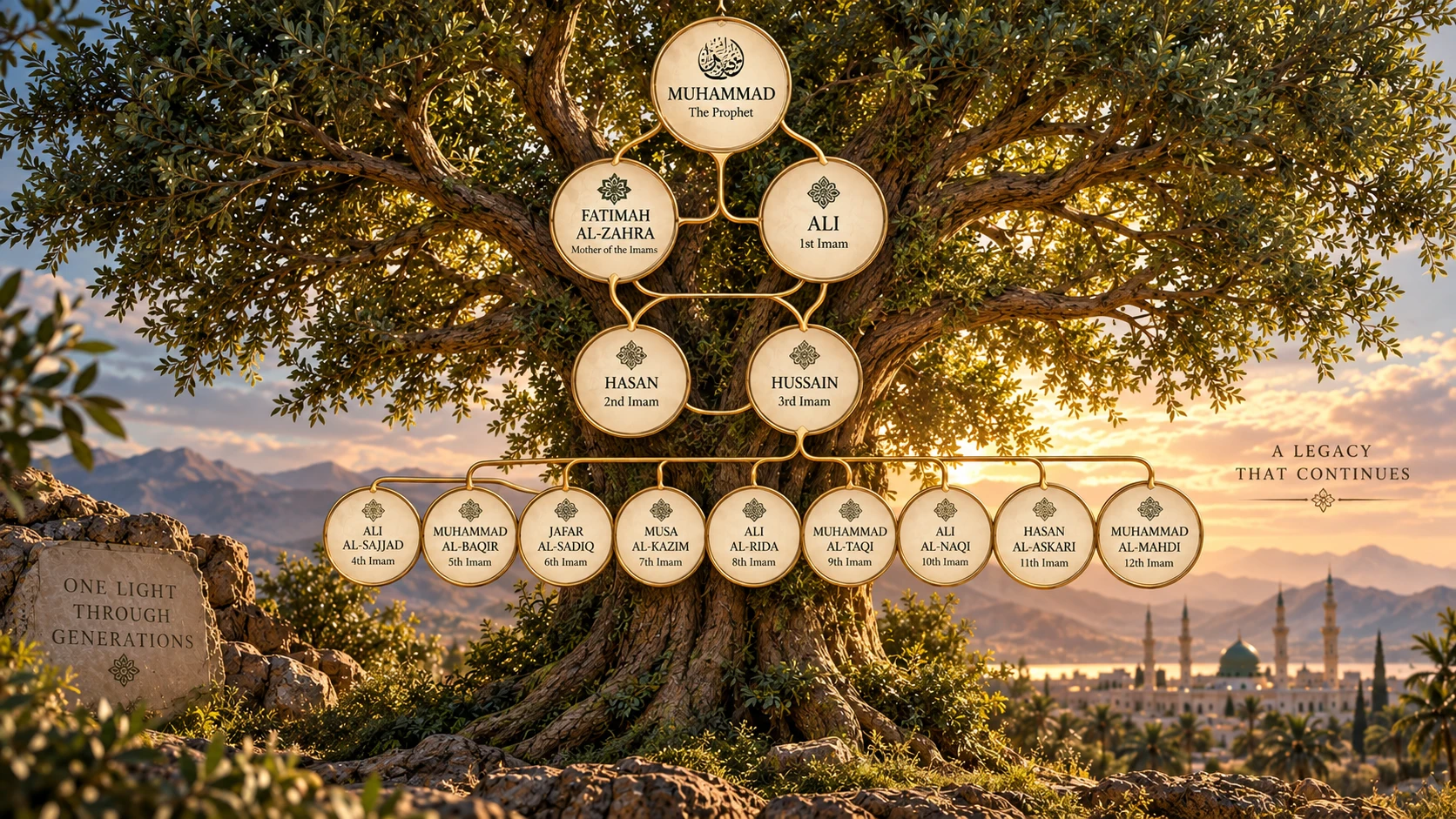
According to Twelver Shi’a belief, the twelve Imams are:
- Imam Ali ibn Abi Talib
- Imam Hasan ibn Ali
- Imam Hussain ibn Ali
- Imam Ali ibn al-Hussain al-Sajjad
- Imam Muhammad al-Baqir
- Imam Ja’far al-Sadiq
- Imam Musa al-Kazim
- Imam Ali al-Rida
- Imam Muhammad al-Taqi (al-Jawad)
- Imam Ali al-Naqi (al-Hadi)
- Imam Hasan al-Askari
- Imam Muhammad al-Mahdi
This list is central to Twelver Shi’a belief.
The twelfth Imam occupies a special position in this tradition. He is identified as Muhammad ibn Hasan al-Askari, known as al-Mahdi, and is believed to be in occultation until his divinely appointed return.
But here is where Fatimah al-Zahra enters the story.
Look carefully at the genealogy.
The first three Imams are:
Ali → Hasan → Hussain
Ali was Fatimah’s husband.
Hasan and Hussain were Fatimah’s sons.
Then the line continues through Hussain:
Hussain → Ali al-Sajjad → Muhammad al-Baqir → Ja’far al-Sadiq → Musa al-Kazim → Ali al-Rida → Muhammad al-Taqi → Ali al-Naqi → Hasan al-Askari → Muhammad al-Mahdi.
This means something historically remarkable happens:
All twelve Imams are connected to the household of Fatimah al-Zahra.
The first Imam was her husband.
The second and third were her sons.
The remaining nine descended through her son Hussain.
Therefore, when Shi’a Muslims call Fatimah Umm al-A’immah — “Mother of the Imams”, the title is not merely poetic language.
It describes her position in the genealogical structure of the Imamate.
3. Why Is Fatimah Called Umm al-A’immah?
At first glance, someone unfamiliar with Islamic history might object:
“But Fatimah was the mother of Hasan and Hussain. How can she be called the mother of all twelve Imams?”
The answer is found in the genealogy.
Fatimah did not personally give birth to all twelve.
She gave birth to Hasan and Hussain.
But Hussain’s descendants became the remaining Imams of the Twelver line.
Therefore, Fatimah stands at the beginning of the entire maternal line through which the Imamate continued.
This is why the title Umm al-A’immah should not be misunderstood as a biological claim that she directly gave birth to twelve sons.
It means that she is the foundational mother of the family from which the twelve Imams emerged.
An important point here is that Fatimah’s significance is not simply that she happened to be related to the Imams. Her position creates a unique bridge between two foundational institutions:
Prophethood through Muhammad ﷺ
and
Imamate through Ali and his descendants.
That is a far more substantial claim than simply calling her “the Prophet’s daughter.”
4. The Remarkable Position of One Woman
Consider the structure carefully.
Fatimah was:
The daughter of Muhammad ﷺ.
She was:
The wife of Ali ibn Abi Talib.
She was:
The mother of Hasan and Hussain.
And through Hussain:
The ancestor of the remaining nine Imams.
This places one woman at the intersection of three generations of sacred history:
Prophet → Fatimah → Imams
There is therefore a logical reason why her position became so significant in Shi’a thought.
She is not an accidental figure standing somewhere inside the family tree.
She is one of its central connecting points.
5. But Is This Enough to Call Her More Than a Historical Mother?
Not by itself.
Genealogy can establish ancestry, but it cannot automatically establish spiritual authority.
A person may be the ancestor of a great intellectual tradition without personally being the source of that tradition.
Therefore, a serious discussion of Fatimah cannot stop at genealogy.
The deeper question is:
Why did early Muslim tradition attach such extraordinary importance to Fatimah herself?
This is where the historical and theological dimensions begin to overlap.
Fatimah was not merely remembered because she had famous descendants.
She was already recognized because of her extraordinary relationship with the Prophet ﷺ and her position within the Prophet’s household.
She was also among the central figures associated with the Ahl al-Bayt and the People of the Cloak.
The event of Mubahalah is particularly significant in this discussion. Sources describe Muhammad ﷺ appearing with Ali, Fatimah, Hasan, and Hussain for the encounter with the Christians of Najran.
This matters because it means Fatimah’s importance cannot be explained solely by what happened generations after her.
Her position was already significant during the Prophet’s lifetime.
6. Fatimah and the Two Lines of Continuity
There is another reason her position becomes intellectually interesting.
The Prophet Muhammad ﷺ left behind two kinds of legacy.
The first was revelation: the Qur’an.
The second was a living community and household that preserved and transmitted his teachings.
In Twelver Shi’a thought, the Ahl al-Bayt became the authoritative continuation of religious guidance.
Fatimah stands at the center of this family.
Her father was the Prophet.
Her husband was Ali.
Her sons were Hasan and Hussain.
Her descendants included the later Imams.
Thus, her household became the point at which the prophetic family and the Imamate became historically connected.
This is why some Twelver descriptions speak of Fatimah as a “confluence of two lights”: the light of prophethood and the light of Imamate.
7. A Question for the Modern Reader
A modern reader, particularly someone who is not Muslim, may still ask:
Why should any of this matter today?
The answer does not require someone to accept the theological conclusions immediately.
One can begin with a historical question:
How does a religious tradition preserve its identity after the death of its founder?
Different civilizations have answered this in different ways.
Some rely primarily on texts.
Some rely on institutions.
Some rely on philosophical schools.
Some rely on hereditary or spiritual leadership.
Twelver Shi’a Islam developed a model in which divine revelation was completed with the Prophet Muhammad ﷺ, while authoritative spiritual leadership continued through a defined succession of Imams.
Whether someone accepts this theology or not, the structure itself can be examined as a coherent religious system.
And within that structure, Fatimah becomes indispensable.
Remove Fatimah from the family chain and the genealogical bridge connecting Muhammad ﷺ to the twelve Imams disappears.
That is not a matter of sentiment.
It is a matter of genealogy.
8. Mother of Two — Ancestor of Eleven
There is an important distinction that is often overlooked.
Fatimah directly gave birth to two sons who became Imams: Hasan and Hussain.
But through Hussain, she became the ancestor of the remaining nine Imams.
Therefore:
Fatimah → Hasan → Imam Hasan
and
Fatimah → Hussain → Imam Hussain → Imam Sajjad → Imam Baqir → Imam Sadiq → Imam Kazim → Imam Rida → Imam Jawad → Imam Hadi → Imam Askari → Imam Mahdi
This makes Fatimah the biological ancestor of the entire line of twelve Imams.
That is why the phrase “Mother of the Imams” carries a meaning much larger than ordinary motherhood.
She is the maternal foundation of the line.
9. Motherhood as a Historical Force
There is another dimension worth considering.
History often remembers rulers, warriors, philosophers, and political leaders while overlooking the women through whom generations were connected.
But genealogy tells a different story.
Dynasties, intellectual families, religious communities, and civilizations frequently survive through mothers whose role is less visible in political narratives.
Fatimah represents an extraordinary example.
Her importance is not derived from political power.
She did not establish an empire.
She did not command an army.
Her historical influence emerged through family, transmission, character, teaching, and legacy.
And through her descendants, her name remained permanently connected with the development of Shi’a Islamic thought.
This is one reason her story can be meaningful even to a reader approaching Islam from outside the faith.
It raises a broader human question:
Can the influence of one person be measured only by what that person personally accomplished, or also by what generations inherited through them?
10. Mother or Myth?
The word “myth” is sometimes used when a historical tradition contains extraordinary religious claims.
But myth and theology should not be confused.
A historical claim can be investigated separately from the theological interpretation placed upon it.
The following facts form the basic historical framework:
- Muhammad ﷺ was Fatimah’s father.
- Ali ibn Abi Talib was her husband.
- Hasan and Hussain were her sons.
- Twelver Shi’a tradition identifies twelve Imams.
- Hasan and Hussain are the second and third Imams.
- The remaining Imams descend through Hussain.
- The twelfth Imam is identified as Muhammad al-Mahdi.
The theological interpretation goes further and attributes divine appointment and spiritual authority to these Imams.
That part belongs to the realm of religious belief and theology.
A thoughtful reader can therefore distinguish between genealogy, historical tradition, and theological interpretation rather than dismissing the entire subject as either unquestionable fact or simple mythology.
11. Why Fatimah’s Position Is Unique
There is perhaps no other woman in Islamic sacred history who occupies exactly the same position.
She connects:
The Prophet and the Imams.
Prophethood and Imamate.
The Prophet’s household and the later generations of his descendants.
Muhammad ﷺ and the twelve-Imam lineage.
This unique position is why Twelver Shi’a tradition places Fatimah among the Fourteen Infallible Ones: Muhammad, Fatimah, and the twelve Imams.
For believers, this is a matter of faith.
For historians, it is a fascinating example of how genealogy, religious authority, memory, and sacred history can converge around one individual.
12. The Last Question
So, was Fatimah al-Zahra merely the mother of two Imams?
Historically, she was the mother of Hasan and Hussain.
But within Twelver Shi’a understanding, her role is much larger.
Through Hasan and especially through Hussain, she became the ancestral mother of the entire line of twelve Imams.
Her father was the final Prophet.
Her husband was the first Imam.
Her sons included the second and third Imams.
Her descendants included the remaining Imams.
And the final Imam in this lineage is believed to be Muhammad al-Mahdi.
That is why Umm al-A’immah — Mother of the Imams — is not simply a poetic title.
It describes a remarkable historical and theological position.
The deeper question, therefore, is not simply:
“Was Fatimah the mother of the Imams?”
The genealogical answer is clear within the Twelver tradition.
The more profound question is:
Why did Islamic history place such an extraordinary concentration of religious meaning around this one woman?
To answer that question, one must go beyond genealogy and examine her relationship with the Prophet, her position among the Ahl al-Bayt, the evidence surrounding her virtues, the concept of Imamate, and the historical development of the Twelve-Imam tradition.
And that is where the story of Fatimah al-Zahra becomes much larger than the story of a mother.
It becomes a story about how a message survives its messenger, how a family becomes a bearer of memory, and how one woman came to stand at the intersection of prophethood and the twelve Imams.