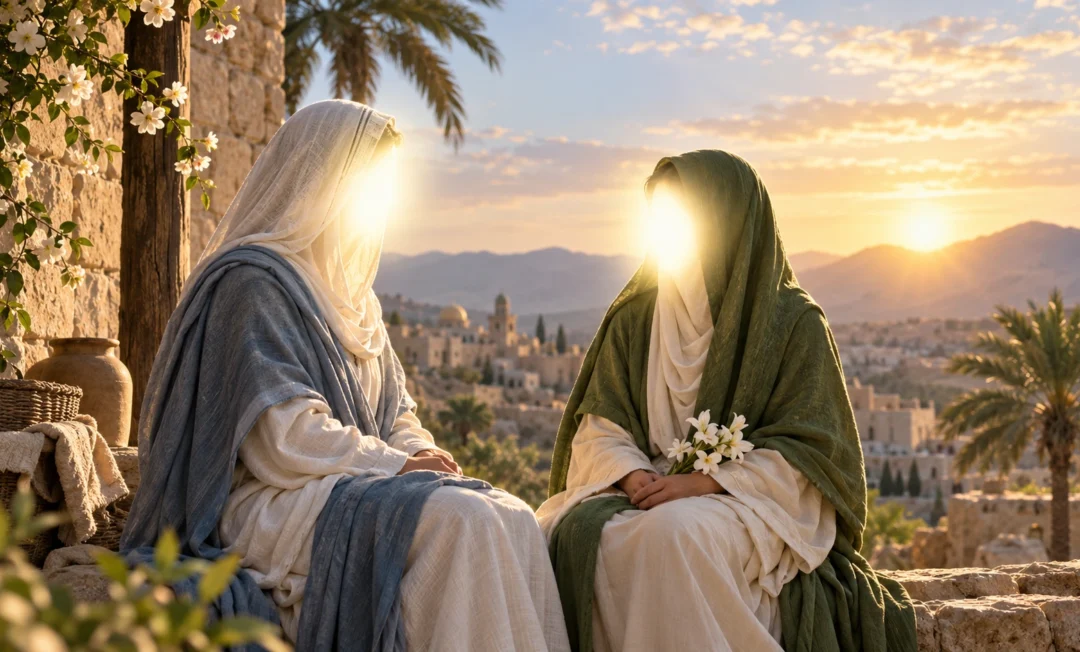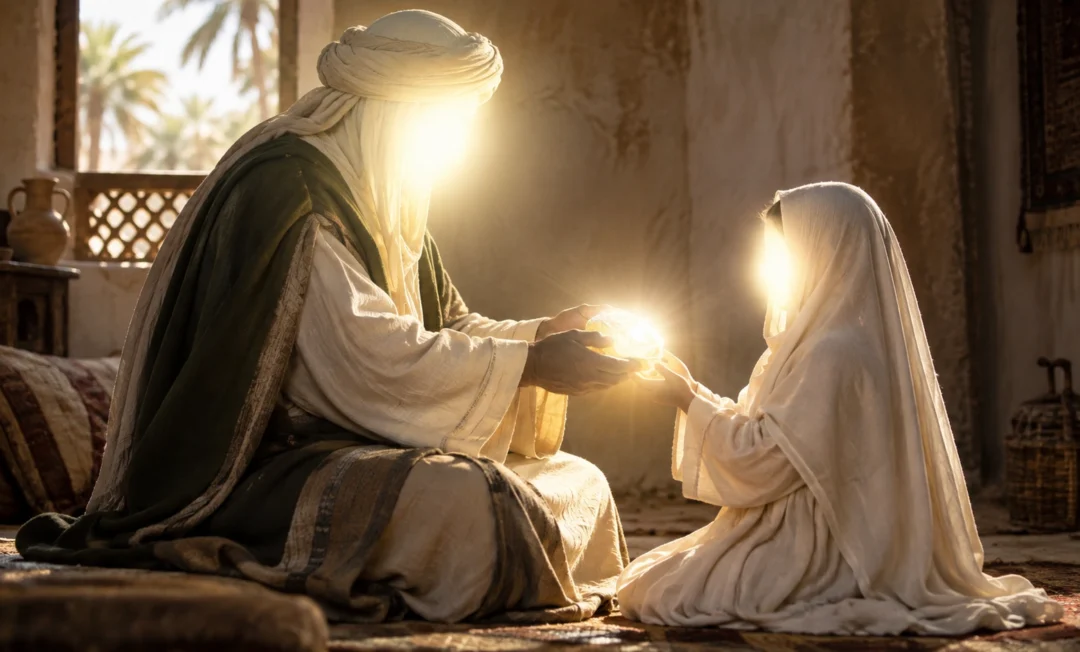

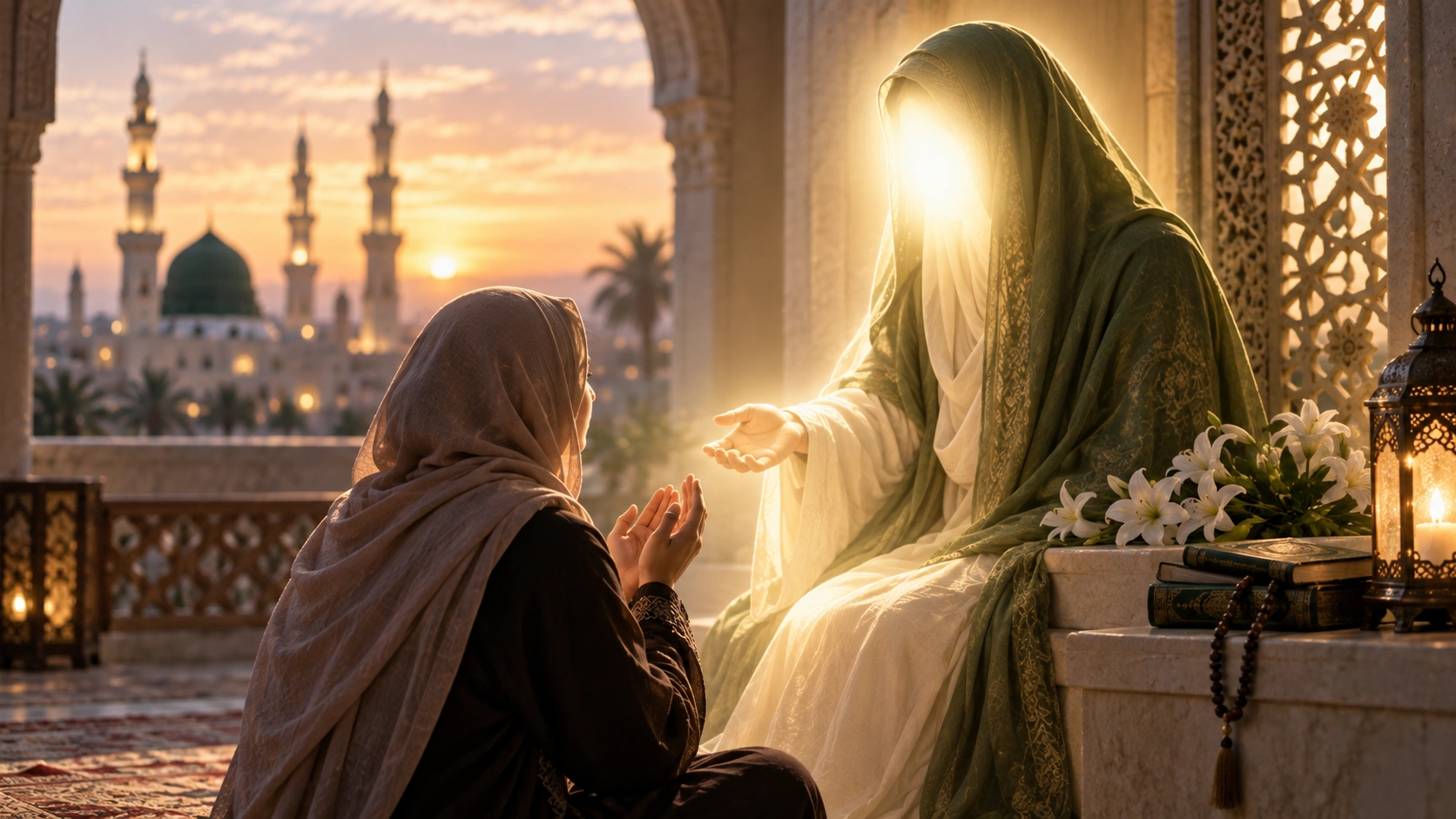
When life becomes difficult, the first place a believer turns is to God. A person may raise their hands and say, “O Allah, help me.” This direct relationship with God is always open. Yet Islamic spirituality also teaches that God has placed means through which His mercy reaches His servants. Among those means are His chosen and beloved servants—the prophets and the Ahl al-Bayt.
For those who follow the tradition of the Ahl al-Bayt, Fatimah al-Zahra, peace be upon her, is not merely a historical figure whose blessings ended with her earthly life. Her spiritual rank, according to Shi’a tradition, remains meaningful after her passing. Believers therefore seek her intercession and turn to her as a means of asking God for mercy, relief, healing, and the resolution of difficulties.
This does not mean replacing God with Fatimah. It means turning to God through a servant whom God has honored and brought close to Himself.
The distinction is essential:
God is the source of every blessing, every cure, every answer to prayer, and every form of help. Fatimah is the means through which a believer seeks that help by God’s permission.
This is why the subject of tawassul—seeking a means of approach to God—is not simply a historical or theological discussion. For a believer, it can become something practical: something to turn to when facing fear, illness, hardship, uncertainty, or a problem that seems impossible to solve.
What Does It Mean to Seek Help Through Fatimah?
When a believer says:
“Ya Fatimah al-Zahra, help me.”
or:
“O Fatimah al-Zahra, intercede for me with Allah.”
the intended meaning, in the Shi’a understanding of tawassul, is not that Fatimah possesses independent power alongside God.
Rather, the believer is asking a beloved servant of God to turn toward God on their behalf, just as one might ask a righteous person during their lifetime to pray for them.
The ultimate request remains directed toward God.
A person may therefore say:
“O Allah, I ask You to relieve my hardship. By the honor of Fatimah al-Zahra, have mercy on me and open a way for me.”
Or:
“O Fatimah al-Zahra, please intercede for me before Allah and ask Him to ease this difficulty.”
The two statements are not contradictory.
One expresses the believer’s direct relationship with God.
The other expresses tawassul—seeking a divinely honored means of approaching Him.
If We Can Ask God Directly, Why Do We Need Tawassul?
This is perhaps the most important question.
If God hears every prayer, why not simply ask Him directly?
The answer is that direct prayer and tawassul are not opposites.
A believer can do both.
The Qur’an says:
“O you who believe! Be mindful of Allah and seek a means of approach to Him.”
(Qur’an 5:35)
The concept of seeking a wasilah, or means of approach to God, is therefore present in the Qur’anic vocabulary itself.
The question is not whether God is capable of answering a prayer directly. Of course He is.
The deeper question is:
Has God also created spiritual means through which His servants may seek His mercy?
In Islamic tradition, the answer is yes.
God could have created the world without physical causes, yet He chose to make many things happen through causes. We eat to satisfy hunger. We take medicine when we are sick. We learn through teachers. We receive knowledge through messengers.
The existence of a means does not diminish God’s power.
The means itself exists because God created it.
In the same way, the believer who seeks the intercession of Fatimah does not believe that God is unable to answer directly. Rather, they believe that God, in His wisdom and mercy, has allowed certain servants to become means of His grace.
The Difference Between Worship and Tawassul
This distinction should always remain clear.
Worship belongs to God alone.
Prayer, ultimate reliance, servitude, and divine lordship belong to Him.
Tawassul is different.
When a person asks Fatimah to intercede, they are not worshipping her. They are asking a servant of God to seek God’s mercy for them.
The distinction can be expressed very simply:
God is the One who answers.
God is the One who heals.
God is the One who removes hardship.
God is the One who grants forgiveness.
Fatimah is the means and intercessor through whom the believer seeks God’s mercy.
This is why tawassul, as understood in Shi’a theology, does not require believing that the Ahl al-Bayt possess independent power.
Whatever ability they possess is given by God, sustained by God, and exercised only within the permission of God.
Why Fatimah al-Zahra?
Why, among all the righteous servants of God, does Fatimah hold such a special place?
Because her position in Islamic tradition is extraordinary.
She was the daughter of the Prophet Muhammad, peace and blessings be upon him and his family. She was the wife of Imam Ali, peace be upon him, and the mother of Imam Hasan and Imam Husayn, peace be upon them.
But her importance does not come merely from her family relationships.
Islamic traditions describe Fatimah through an extraordinary collection of spiritual qualities: faith, purity, truthfulness, worship, knowledge, patience, modesty, sacrifice, and closeness to God.
She experienced hardship from an early age, witnessed the suffering endured by the Prophet, lived through the difficulties faced by the early Muslim community, and experienced profound grief after the death of her father.
Yet her life remained centered upon God.
Her nights were connected with worship.
Her heart was connected with faith.
Her concern extended beyond herself.
And her position within the household of the Prophet gave her a unique place in Islamic history.
For the believer who practices tawassul, these qualities are precisely what make Fatimah a profound spiritual means.
The Chosen Servants of God Are Tested Before They Are Raised
There is another important principle behind the concept of divine friendship.
The great servants of God were not given their spiritual rank simply as a worldly privilege. Their lives were filled with tests.
Mary, peace be upon her, endured one of the most difficult trials imaginable.
The Prophet Muhammad endured persecution, rejection, hunger, loss, and struggle.
Fatimah witnessed the suffering of her father and endured severe trials herself.
The prophets and righteous servants of God were tested, and through faith, patience, obedience, and sacrifice, they demonstrated their closeness to Him.
This gives another meaning to tawassul.
When a believer turns toward a person whom God has honored after a life of extraordinary obedience, they are not merely calling upon a famous historical figure.
They are seeking the intercession of someone whose entire life was directed toward God.
Does God Show Special Mercy Because He Loves His Chosen Servants?
This is an important part of understanding intercession.
The believer does not imagine that Fatimah can force God to do something against His will.
That would contradict the very foundation of Islamic belief.
Rather, the idea is that God Himself grants certain servants a special rank and permits them to intercede.
The Qur’an repeatedly establishes that intercession ultimately belongs to God and occurs only according to His permission.
This means that when a believer seeks Fatimah’s intercession, they are ultimately asking God to show mercy through a servant whom He loves.
One might express the meaning of tawassul in this way:
“O Allah, I am Your servant. I have weaknesses, mistakes, and shortcomings. I come to You with hope rather than claiming that I deserve Your favor. I ask You, by the honor of Fatimah al-Zahra, to have mercy upon me, forgive me, and open the way out of this difficulty.”
This is not an attempt to pressure God.
It is an appeal to His mercy.
What If Our Own Sins Stand Between Us and Our Prayers?
Every human being knows this feeling.
We make mistakes.
We become careless.
We commit sins.
We sometimes remember God only after a crisis has already begun.
Then, when we need something desperately, we may wonder:
“Who am I to ask God for such a great thing?”
But Islam does not teach the sinner to abandon prayer.
Quite the opposite.
The Qur’an says:
“Do not despair of the mercy of Allah.”
(Qur’an 39:53)
The door of repentance remains open.
A person’s sins do not mean that they should stop asking God.
At the same time, tawassul can give a believer another way of expressing humility:
“O Allah, I know my own shortcomings. I know that I have not worshipped You as I should. I have come to You with my weakness. I ask You, through the honor of Fatimah al-Zahra, to forgive me and answer my prayer.”
In this sense, tawassul does not replace repentance.
It deepens the believer’s appeal to God’s mercy.
Why Would God Give Us a Means of Intercession?
Consider how many things in creation work through means.
God sends rain, and the earth produces crops.
God creates healing, yet a physician may become the means through which treatment reaches a patient.
God gives knowledge, yet a teacher may become the means through which that knowledge reaches a student.
God gives guidance, yet He sent prophets to communicate that guidance to humanity.
The existence of a means does not mean that the means operates independently.
It means that God has chosen to make certain effects occur through certain channels.
From the perspective of tawassul, the same principle applies spiritually.
God does not need Fatimah.
We need God.
But God may choose to allow Fatimah to become a means through which His mercy reaches us.
That is not a limitation upon God.
It is an expression of His wisdom.
Does Fatimah’s Blessing End With Her Earthly Life?
This question becomes especially important when we speak about seeking Fatimah’s help today.
If Fatimah is no longer physically present among us, how can a believer turn toward her?
Islamic belief does not understand death as simple annihilation.
The Qur’an speaks about those who are killed in God’s way:
“Do not think of those who are killed in the way of Allah as dead. Rather, they are alive with their Lord, receiving provision.”
(Qur’an 3:169)
The Islamic understanding of the afterlife therefore includes forms of existence that are beyond ordinary physical perception.
Within Shi’a tradition, the Prophet and the Ahl al-Bayt are understood to possess a special spiritual life after their earthly departure, and tawassul to them is not restricted to the period in which they were physically present among people.
This is why visiting their graves, sending salutations, remembering them, and seeking their intercession remain meaningful practices for believers.
The underlying principle remains the same:
Their spiritual role does not mean independence from God.
If they possess knowledge, awareness, intercession, or the ability to assist, these are understood as gifts and permissions granted by God.
Could the Ahl al-Bayt Have Greater Freedom in the Next Life?
There is a profound theological idea behind this.
During earthly life, even a prophet or saint is living within the limitations of the physical world. After death, however, the believer enters another stage of existence.
The Qur’an itself tells us that the realities of the unseen are far greater than what ordinary human perception can observe.
For this reason, Shi’a scholars and believers understand the spiritual relationship between the faithful and the Ahl al-Bayt as continuing after their earthly lives.
This does not mean that we should invent details about the unseen that revelation has not established.
Rather, it means that we should not assume that death automatically ends every form of spiritual awareness or intercession.
The limits of our physical perception are not necessarily the limits of God’s creation.
Stories of Healing and Unexpected Relief
Across generations, believers have reported experiences in which they turned to Fatimah al-Zahra or another member of the Ahl al-Bayt during severe hardship and later experienced relief.
Some people describe recovery from illness.
Others speak of financial problems being unexpectedly resolved.
Some recount family difficulties that suddenly changed.
Others describe finding a solution when every ordinary path seemed closed.
These testimonies are an important part of the living devotional culture surrounding the Ahl al-Bayt.
At the same time, there is a distinction worth preserving.
A personal testimony is evidence of what a person experienced; it is not automatically scientific proof of the cause of that experience.
For a believer, however, such experiences can strengthen faith in a spiritual practice that has been passed from generation to generation.
And perhaps the most important point is this:
The purpose of tawassul is not to turn faith into a mechanical formula.
It is to deepen the believer’s relationship with God through the people whom God has honored.
What About Evil, Satan, and Spiritual Harm?
Islam teaches that human beings face not only physical difficulties but also spiritual challenges.
The Qur’an speaks of Satan, temptation, whispering, and the need to seek refuge in God.
At the same time, Islam gives believers spiritual practices for protection: prayer, remembrance of God, recitation of the Qur’an, seeking refuge in Allah, repentance, and supplication.
This gives us an important principle.
If Islam recognizes that spiritual evil can affect human beings through temptation and whispering, it would be inconsistent with the idea of divine mercy to imagine that believers have been left without spiritual protection.
God has given human beings means of seeking refuge in Him.
But we should also avoid attributing every illness, family problem, financial difficulty, or unfortunate event to Satan or supernatural causes. Many difficulties have ordinary physical, psychological, social, or economic explanations and require practical solutions.
Faith and practical effort should work together.
A sick person can pray and seek tawassul while also seeing a qualified doctor.
A person in financial difficulty can pray while also working, planning, and seeking legitimate assistance.
A person facing a family problem can pray while also communicating, seeking advice, and taking appropriate action.
Tawassul does not tell us to abandon the means available to us.
It teaches us to seek God’s help through both spiritual and practical means.
How Can We Turn to Fatimah in a Time of Difficulty?
The practice does not need to be complicated.
When you are facing a serious problem, find a quiet place and begin by turning directly toward Allah.
You can make wudu if possible.
Pray two units of prayer if appropriate.
Then send blessings upon the Prophet and his family.
You may say:
Salawat
“Allahumma salli ‘ala Muhammadin wa ali Muhammad.”
Meaning:
“O Allah, bless Muhammad and the family of Muhammad.”
Then speak to God directly.
Tell Him exactly what you are going through.
Do not hide your weakness.
Do not pretend to be stronger than you are.
Then you may turn to Fatimah al-Zahra and say:
A Simple Supplication
“Ya Fatimah al-Zahra, ishfa’i li ‘ind Allah.”
Meaning:
“O Fatimah al-Zahra, intercede for me with Allah.”
Then return your attention to God:
“O Allah, by the honor of Fatimah al-Zahra, relieve my hardship, forgive my shortcomings, and open a way for me that is good for my faith and my life.”
You can then mention your specific need.
Three Short Remembrances for Difficult Times
These are simple expressions that can be incorporated into personal supplication.
1. Salawat
“Allahumma salli ‘ala Muhammadin wa ali Muhammad.”
Repeat it calmly and attentively, then ask Allah for your need.
2. Seeking the Intercession of Fatimah
“Ya Fatimah al-Zahra, ishfa’i li ‘ind Allah.”
“O Fatimah al-Zahra, intercede for me with Allah.”
Then make your request directly to Allah.
3. A Direct Prayer Through Her Honor
“O Allah, by the honor of Fatimah al-Zahra, have mercy on me, forgive me, and relieve this hardship.”
This last form makes the central principle especially clear: the request is ultimately being made to God.
Does Tawassul Require Certainty in the Heart?
Yes—but we should understand what certainty means.
It does not mean believing that we can command God.
It does not mean demanding that God give us exactly what we want at exactly the time we want it.
And it does not mean repeating a phrase mechanically while expecting a guaranteed worldly result.
True spiritual certainty means trusting that:
God hears.
God knows.
God is merciful.
God is capable.
God does not abandon His servants.
A person can have strong hope in the intercession of Fatimah while still submitting the final outcome to God’s wisdom.
This is an important balance.
Ask with hope, not entitlement.
Ask with faith, not superstition.
Ask with sincerity, not as a mechanical formula.
And leave the final decision to God.
What If the Answer Does Not Come Immediately?
This is where patience becomes part of faith.
Sometimes a person asks for something and receives it quickly.
Sometimes the answer takes time.
Sometimes the form of the answer is different from what the person expected.
And sometimes a person may never understand in this life why a particular prayer unfolded the way it did.
That does not mean the prayer was meaningless.
The believer’s responsibility is to ask, trust, repent, act, and remain patient.
Tawassul is not a contract in which a particular phrase obligates God to produce a particular outcome.
It is an act of hope and devotion.
The Living Meaning of Fatimah Today
This is perhaps the most important reason to speak about Fatimah al-Zahra in the present tense.
She is not merely a name in a history book.
Her life continues to speak to people who face difficulties today.
The woman who endured hardship can teach us patience.
The woman who worshipped can teach us how to return to God.
The woman who placed others before herself can teach us generosity.
The woman who stood for what she believed was right can teach us courage.
And the woman who occupies such a high position in the spiritual tradition of the Ahl al-Bayt can become, for believers, a means through which they seek God’s mercy.
This is why the subject of Fatimah should not remain merely academic.
Faith becomes truly meaningful when it enters the difficult moments of our lives.
When fear comes, remember God.
When hardship comes, call upon God.
When you feel unworthy, repent and return to God.
And when you seek a means of approaching Him, turn with respect toward those whom you believe He has chosen and honored.
God Is the Destination; Fatimah Is the Means
Perhaps the entire meaning of tawassul can be summarized in one simple principle:
We do not turn away from God to turn toward Fatimah. We turn toward Fatimah so that, through her intercession, we may turn more deeply toward God.
God is the One who gives.
God is the One who heals.
God is the One who forgives.
God is the One who removes hardship.
God is the One who opens closed doors.
God is the One who answers prayer.
And if He has granted His beloved servants a special position, and if He has permitted them to intercede for His servants, then seeking their intercession is ultimately another expression of hope in His mercy.
So when a difficulty comes, you do not have to choose between direct prayer and tawassul.
You can raise your hands and say:
“O Allah, help me.”
Then you can say:
“O Fatimah al-Zahra, intercede for me before Allah.”
And finally:
“O Allah, by the honor of Fatimah al-Zahra, have mercy upon me and open a way out of this hardship.”
The words may be simple.
The need may be enormous.
But the believer approaches with humility, faith, repentance, hope, and certainty that all mercy ultimately comes from Allah.
God is the destination.
Fatimah is the means.
Intercession is by God’s permission.
And hope belongs to the believer who refuses to despair of God’s mercy.