
Fatimah al-Zahra (peace be upon her) and Imam Ali ibn Abi Talib (peace be upon him) formed one of the most revered households in Islamic history. Their marriage was marked by simplicity, devotion, mutual respect, and a deep commitment to the faith of Prophet Muhammad (peace and blessings be upon him and his family).
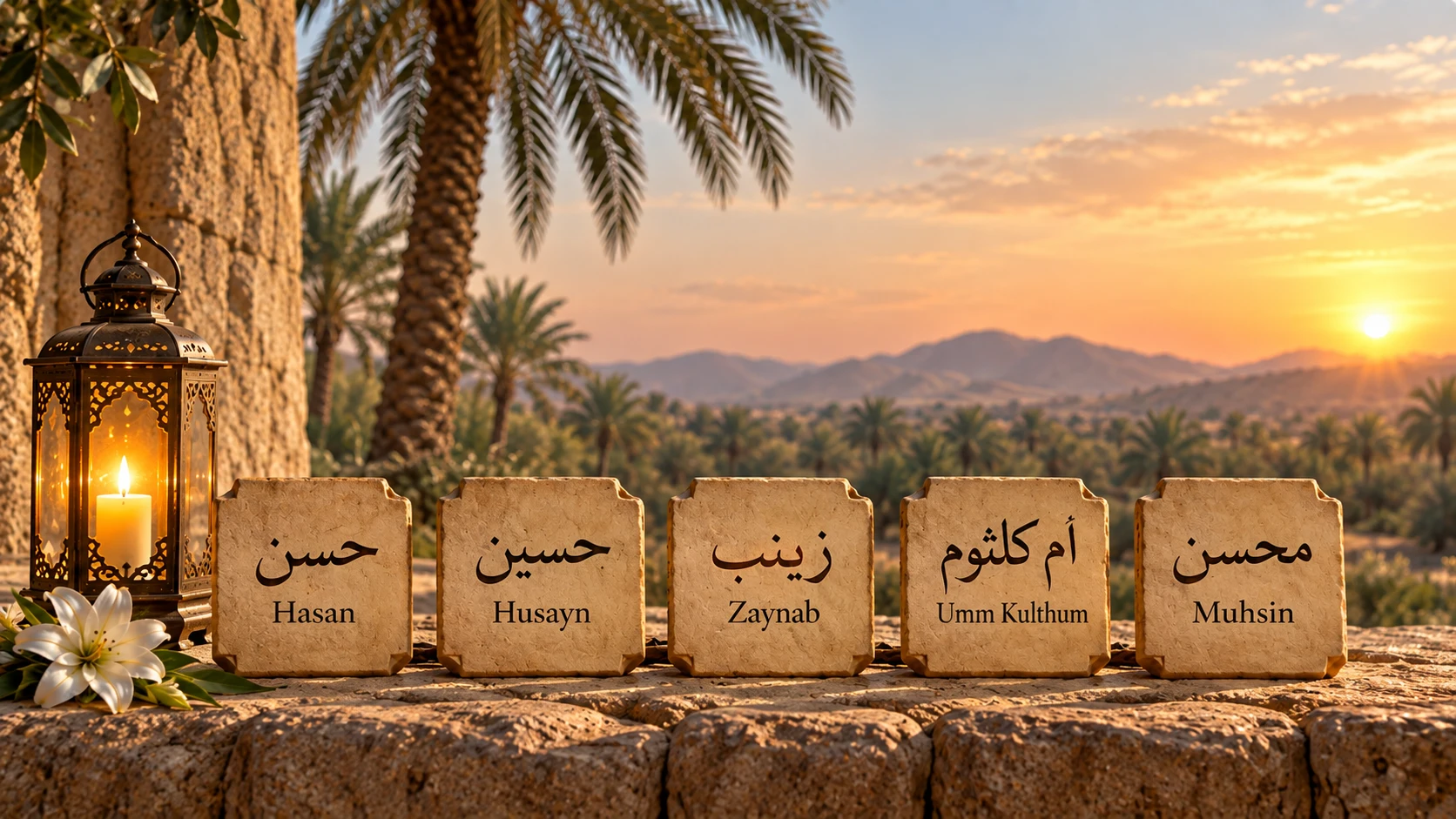
The fruit of this blessed marriage is traditionally described as five children: Imam Hasan, Imam Hussain, Lady Zaynab, Lady Umm Kulthum, and Muhsin. The first four lived to become important figures in Islamic history, while Muhsin, according to Shi’a sources, was lost before birth in the events that followed the death of the Prophet.
The importance of this family goes far beyond genealogy. Through Fatimah, the Prophet’s family continued through her descendants, and in Shi’a tradition she is therefore known as Umm al-A’immah — the Mother of the Imams.
The lives of her children also became closely connected with some of the most significant chapters in Islamic history: the caliphate of Imam Ali, the peace agreement of Imam Hasan, the tragedy of Karbala, and the courageous mission of Lady Zaynab after Ashura.
A Family With an Extraordinary Legacy
The marriage of Fatimah and Ali took place in Madinah according to the commonly cited account, and their family was raised in close proximity to the Prophet Muhammad. The marriage itself was characterized by simplicity and mutual affection. Ali is reported to have said that throughout Fatimah’s life, he never angered her and she never angered him.
Their children therefore grew up in an exceptional environment.
Their grandfather was the Messenger of Allah.
Their father was Ali ibn Abi Talib, the first Imam, one of the closest companions and relatives of the Prophet.
Their mother was Fatimah al-Zahra, the beloved daughter of the Prophet and one of the most honored women in Islamic tradition.
This family became one of the central branches through which the Prophet’s descendants are remembered.
In Twelver Shi’a tradition, the later Imams descend from Imam Husayn, making Fatimah the link through which the line of the Imams connects back to the Prophet Muhammad. This is one of the reasons for her title Umm al-A’immah, meaning Mother of the Imams.
Imam Hasan: The Elder Son
Imam Hasan ibn Ali (peace be upon him) was the first son of Fatimah and Ali and the first grandson of Prophet Muhammad.
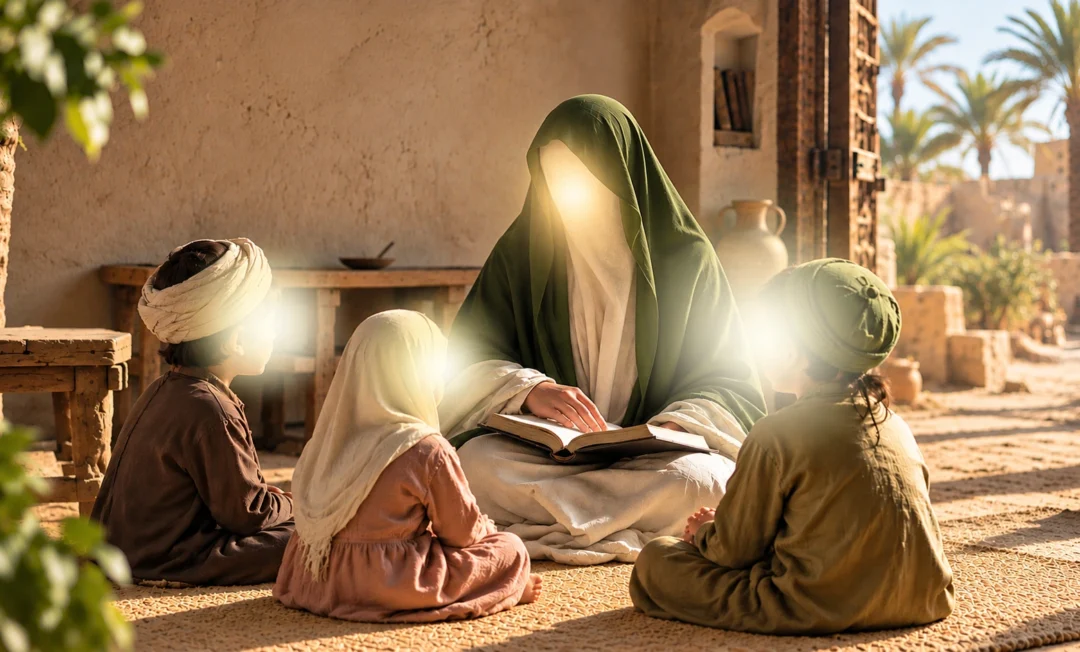
He was raised under the care of Fatimah and Ali and had a particularly close relationship with his grandfather. Accounts of his childhood portray him growing up in an atmosphere of worship, knowledge, affection, and close contact with the Prophet.
One of the traditions concerning his childhood describes Fatimah encouraging Hasan to listen carefully to the Prophet’s teachings and then return home and tell her what he had learned. In this way, religious learning became part of his everyday family life.
His upbringing was not limited to formal instruction. Hasan witnessed his mother’s worship, generosity, patience, and concern for others.
One of the most famous reports concerning Fatimah’s worship is connected with Hasan himself. He is said to have watched his mother spend the night in prayer, repeatedly praying for believing men and women. When he asked why she did not pray for herself first, she answered:
“First the neighbor, then ourselves.”
For Hasan, this was more than a sentence. It was a lesson in selflessness that came directly from his mother’s example.
The Peace of Imam Hasan
After the martyrdom of Imam Ali, Hasan assumed the leadership of the Muslim community according to Shi’a belief. A large number of people pledged allegiance to him, but his position soon came under pressure from Mu’awiyah, who opposed his authority and mobilized forces against him.
The conflict placed Hasan in an extremely difficult position. His army suffered from division, political pressure, and defections, while attempts were made to undermine his authority.
Eventually, Imam Hasan accepted a peace agreement with Mu’awiyah under conditions intended to protect the Muslim community and preserve the principles of Islam. Among the reported conditions were that Mu’awiyah should govern according to the Qur’an and the Sunnah, should not appoint a successor, and should guarantee security for the people, including the followers of Ali.
The agreement became one of the defining moments of Hasan’s life.
Later, according to the traditional account, Mu’awiyah violated the conditions and eventually sought to secure allegiance for his son Yazid. Imam Hasan was later poisoned and died after suffering from the effects of the poisoning.
His life is remembered for patience, dignity, generosity, and a willingness to place the welfare of the Muslim community above personal ambition.
Imam Hussain: The Voice of Karbala
Imam Hussain ibn Ali (peace be upon him) was the second son of Fatimah and Ali and one of the most revered figures in Islamic history.
Known by his kunyah Abu Abdullah, Husayn became the third Imam in Twelver Shi’a Islam and is remembered by the title Sayyid al-Shuhada — the Master of the Martyrs.
Like his brother Hasan, Hussain was raised in the household of Fatimah and Ali and enjoyed a close relationship with his grandfather, Prophet Muhammad.
The traditions about Fatimah’s motherhood also preserve tender memories of her relationship with Hussain. She played with her children, spoke to them affectionately, and responded to their needs with great care.
But Hussain’s later life would place him at the center of one of the most painful and influential events in Islamic history.
Karbala and the Stand of Imam Hussain
After the death of Mu’awiyah, his son Yazid sought allegiance from Hussain.
Hussain refused to give his allegiance to Yazid.
He eventually left Madinah and travelled toward Makkah. The people of Kufa invited him to come to their city, promising their support, and Hussain sent his cousin Muslim ibn Aqil to investigate the situation.
Political pressure and the actions of the authorities in Kufa eventually caused the promised support to collapse.
Hussain’s caravan was intercepted on the journey and ultimately reached Karbala in the year 61 AH.
On the tenth day of Muharram, Ashura, Imam Hussain and his companions faced the forces sent against them.
The battle ended with the martyrdom of Hussain and many members of his family and companions.
For Shi’a Muslims, Karbala represents much more than a historical battle. It is remembered as a defining stand for truth, justice, dignity, and resistance to oppression.
The sacrifice of Hussain also profoundly shaped the religious and cultural memory of Muslims far beyond the borders of the communities that commemorate Ashura.
Lady Zaynab: The Daughter Who Carried the Message
Lady Zaynab bint Ali (peace be upon her) was the eldest daughter of Fatimah and Ali and one of the most remarkable women in Islamic history.
She was known for her worship, knowledge, eloquence, patience, and courage.
Zaynab grew up in a household unlike any other. Her grandfather was the Prophet, her father was Ali, and her mother was Fatimah. From them she inherited not only lineage but also a profound religious and moral education.
Her life after Karbala would reveal the extraordinary strength that had been cultivated within that household.
Zaynab After Karbala
Zaynab was present during the tragedy of Karbala and witnessed the deaths of her brothers, relatives, and companions.
Yet the story did not end with the death of Imam Husayn.
After the battle, Zaynab became one of the principal voices conveying what had happened.
She spoke publicly and fearlessly, challenging the authorities and ensuring that the meaning of Husayn’s sacrifice would not disappear beneath political propaganda.
Her courage after Karbala became an essential part of the memory of the event.
She demonstrated that resistance does not always take the form of a battlefield. Sometimes it takes the form of speaking the truth after everyone else has been silenced.
For this reason, Zaynab is remembered as one of the great examples of courage, patience, faith, and steadfastness in Islamic history.
Umm Kulthum: A Daughter of the House of Revelation
Umm Kulthum bint Ali was another daughter of Fatimah and Ali.
She is remembered in Islamic historical traditions as a noble, intelligent, and eloquent woman.
Although fewer details of her life have survived in comparison with those of Hasan, Husayn, and Zaynab, she belonged to the same household and shared in the spiritual and moral environment created by Fatimah and Ali.
Her importance is also connected with the events following Karbala. Traditional accounts remember Umm Kulthum as being present alongside Zaynab and participating in conveying the suffering and injustice experienced by the family of the Prophet.
Together, the two sisters became part of the voice through which the story of Karbala reached the wider Muslim community.
Muhsin: The Child Who Was Never Born
The fifth child of Fatimah and Ali is known in Shi’a tradition as Muhsin ibn Ali.
His story is very different from that of his brothers and sisters.
According to the Shi’a historical account reflected in the sources provided for this article, Muhsin was lost through miscarriage during the events surrounding the attack on Fatimah’s house after the death of Prophet Muhammad. The exact date of his death is not established in the supplied material.
The account places his loss in the aftermath of the dispute over allegiance and the events involving the house of Fatimah.
Because this subject is closely connected with disputed early Islamic history, it is important to distinguish the Shi’a account from historical interpretations that do not accept the same narrative.
Within Shi’a tradition, however, Muhsin is regarded as a member of the Prophet’s family and his loss is remembered with grief.
His story is sometimes described as that of “the child who was never born”—a brief life whose place remains deeply significant in the devotional memory of the Ahl al-Bayt.
From Fatimah to the Imams
The significance of Fatimah’s children becomes even greater in Shi’a theology because the line of the Imams continues through them.
Imam Hasan and Imam Hussain were the Prophet’s grandsons through Fatimah.
After Imam Hasan, the line of the Imams in Twelver Shi’a tradition continues through Imam Hussain’s descendants. Thus, the later Imams are connected to the Prophet Muhammad through Fatimah al-Zahra.
This gives Fatimah a unique position in the history of the Ahl al-Bayt.
She was not simply the daughter of the Prophet.
She was also the mother through whom the lineage of the Imams continued.
This is the deeper meaning behind the title Umm al-A’immah — Mother of the Imams.
A Family Shaped by Fatimah
The remarkable lives of Fatimah’s children invite another question:
What kind of mother raised such a family?
The answer is found in the details of Fatimah’s daily life.
She taught through worship.
She taught through generosity.
She taught through patience.
She taught through affection.
She played with her children, listened to them, answered their questions, encouraged them to learn, and showed them through her own actions what faith meant.
Her children saw her give food to those in need even when the family itself had little. They saw her spend nights in prayer. They heard her pray for others before herself.
They therefore inherited more than a noble lineage.
They inherited a way of living.
The Family’s Enduring Influence
Each of Fatimah’s children left a different mark on Islamic history.
Hasan became a symbol of patience, reconciliation, and dignity.
Hussain became the enduring symbol of sacrifice and resistance to oppression.
Zaynab became a symbol of courage, eloquence, and preserving the truth after tragedy.
Umm Kulthum became part of the family that carried the memory of Karbala forward.
Muhsin, though his life ended before birth according to the Shi’a account, remains an important figure in the devotional memory of Fatimah’s family.
Together, they represent a family whose influence extended far beyond their own generation.
More Than a Family Tree
It is easy to look at the children of Fatimah and Ali simply as a genealogy.
But their story is much deeper.
This was a family shaped by the Prophet’s teachings and by the example of Fatimah and Ali. Their lives became intertwined with questions of faith, leadership, justice, sacrifice, patience, and truth.
The importance of Fatimah’s children is therefore not merely that they were descendants of the Prophet.
It is that their lives became part of the continuing story of the values associated with the Ahl al-Bayt.
The Legacy of Fatimah Lives Through Her Children
The story of Fatimah al-Zahra cannot be separated from the story of her children.
Through Hasan and Hussain, her motherhood became connected with two of the most important figures of the Prophet’s family.
Through Zaynab, her courage and spiritual strength continued to speak after Karbala.
Through the descendants of Husayn, the line of the Imams continued according to Shi’a belief.
And through all of them, the memory of Fatimah remained alive.
Her household was materially simple, but its spiritual influence was immense.
The home of Fatimah and Ali was small in size, yet the legacy that emerged from it became one of the most enduring legacies in Islamic history.
A Mother’s Legacy
The story of the children of Fatimah and Ali ultimately brings us back to Fatimah herself.
A mother’s influence is not always measured by the years she lives or the possessions she leaves behind.
Sometimes it is measured by the character of the children she raises.
Fatimah’s children carried her teachings into very different circumstances. Some faced political conflict. One faced Karbala. Another carried the message of Karbala to the wider world. Yet the values associated with their upbringing remained recognizable: faith, courage, patience, generosity, dignity, and devotion to Allah.
That is perhaps the most powerful dimension of Fatimah’s legacy.
She raised a family whose story continued long after her own life had ended.