

The birth of Fatimah al-Zahra (peace be upon her) holds a special place in Islamic history and tradition. She was the beloved daughter of the final Prophet, Muhammad (peace and blessings be upon him and his family), and Khadijah al-Kubra (peace be upon her).
Her father, Prophet Muhammad, was the final messenger of God and, according to Islamic belief, the noblest of His creation. Her mother, Khadijah, was one of the most respected women of Quraysh and the first woman to accept Islam. She devoted her wealth, influence, and entire life to supporting the Prophet and the early Muslim community.
Even before the rise of Islam, Khadijah was renowned for her purity and honorable character. She was known by the title al-Tahirah, meaning the Pure One.
The birth of Fatimah al-Zahra therefore holds a special place in Islamic tradition, particularly in accounts concerning the Prophet’s family and the continuation of his lineage.
When Was Fatimah al-Zahra Born?
According to widely cited Shi’a sources, the birth of Fatimah al-Zahra took place in Makkah on the 20th of Jumada al-Thani, five years after the beginning of the Prophet Muhammad’s mission.
There is, however, a difference of opinion among historical sources concerning the exact date of her birth. Many Sunni sources place her birth approximately five years before the beginning of the Prophet’s mission, during the period when Quraysh was rebuilding the Ka’bah. Some other reports place it in the second year after the beginning of the Prophet’s mission.
Shi’a sources generally give the date as the 20th of Jumada al-Thani in the fifth year after the beginning of revelation.
Despite these differences concerning chronology, Fatimah al-Zahra’s exceptional position as the daughter of Prophet Muhammad is recognized throughout Islamic history.
The Blessed Birth of Fatimah al-Zahra
Several traditional narrations describe extraordinary events surrounding the conception and birth of Fatimah al-Zahra.
According to one well-known narration, before Fatimah was conceived, God commanded Prophet Muhammad to separate himself from Khadijah for forty days. During this period, the Prophet devoted himself to fasting and worship.
At the end of the forty days, the Angel Gabriel came to the Prophet with food from Paradise and instructed him to break his fast with it by God’s command.
After completing his worship and returning to Khadijah, Fatimah al-Zahra was conceived that night.
Another traditional narration connects her conception with the Prophet’s Mi’raj, or heavenly ascension. According to this account, the Prophet was given a fruit from Paradise during the Mi’raj, and after consuming it, Fatimah was conceived.
These reports are part of the traditional Islamic literature concerning the extraordinary circumstances associated with the birth of Fatimah al-Zahra.
Glad Tidings Given to Khadijah
During Khadijah’s pregnancy, traditional narrations describe the Prophet Muhammad giving her glad tidings concerning her unborn daughter.
According to one narration, the Prophet told Khadijah that the Angel Gabriel had informed him that the child would be a girl and that she would become the source of a blessed and pure lineage.
The narration further describes Fatimah as being destined to play a central role in the continuation of the Prophet’s family after him.
For Muslims who honor the Ahl al-Bayt, these reports emphasize the extraordinary spiritual significance attributed to Fatimah even before her birth.
Why Was She Named Fatimah?
The Prophet Muhammad named his daughter Fatimah.
Traditional narrations give several explanations for this name. One famous narration states:
“Allah separated my daughter Fatimah, her children, and those who love them from the Fire.”
The Arabic word Fatimah is traditionally associated with the meaning of being separated, weaned, or protected from something. Islamic narrations therefore connect her name with her special spiritual status and her separation from evil and the Fire.
Her name, Fatimah al-Zahra, is often understood as Fatimah the Radiant or Fatimah the Luminous, reflecting the reverence with which she is regarded in Islamic tradition.
Fatimah al-Zahra and Surah al-Kawthar
Fatimah al-Zahra is also closely associated in Shi’a interpretation with Surah al-Kawthar, the 108th chapter of the Qur’an.
Allah says:
“Indeed, We have granted you al-Kawthar. So pray to your Lord and sacrifice. Indeed, your enemy is the one cut off.”
— Qur’an 108:1–3
Many Shi’a commentators, along with some prominent Sunni scholars, have interpreted al-Kawthar as referring, at least in part, to abundant goodness and the blessed continuation of the Prophet’s lineage through Fatimah.
The final verse of the surah is particularly significant in this interpretation. The Prophet’s enemies had mocked him as abtar, meaning cut off or without descendants, because his sons had died during his lifetime.
The revelation of Surah al-Kawthar is therefore understood as a divine response to those accusations: the Prophet would not be without a lasting legacy. Instead, God would grant him abundant goodness and a blessed lineage.
Through Fatimah al-Zahra, the descendants of the Prophet Muhammad continued through the generations.
The Extraordinary Birth of Fatimah
A detailed traditional account of Fatimah’s birth is attributed to Imam Ja’far al-Sadiq and preserved in the works of Islamic scholars such as Shaykh al-Saduq.
According to this narration, after Khadijah married the Prophet Muhammad, the women of Makkah distanced themselves from her because she had married Muhammad despite opposition from the Quraysh.
When Khadijah became pregnant with Fatimah, however, she experienced comfort and companionship from the unborn child. According to the narration, Fatimah would speak to her mother from within the womb and console her during those difficult days.
When the time of the birth approached, Khadijah sent a message to the women of Quraysh asking them to come and assist her.
They refused.
They reminded Khadijah that she had not followed their wishes and had married Muhammad, whom they referred to as the orphan of Abu Talib. As a result, they said they would not come to assist her during childbirth.
Khadijah was deeply saddened by their rejection.
Then, according to the narration, four noble women appeared before her. They reassured Khadijah and told her not to be afraid or sorrowful.
One of them identified herself as Sarah, the wife of Prophet Abraham. Another was Asiyah, the wife of Pharaoh, while the others were identified as Maryam, the daughter of Imran, and Kulthum, the daughter of Prophet Moses.
They told Khadijah that God had sent them to assist her.
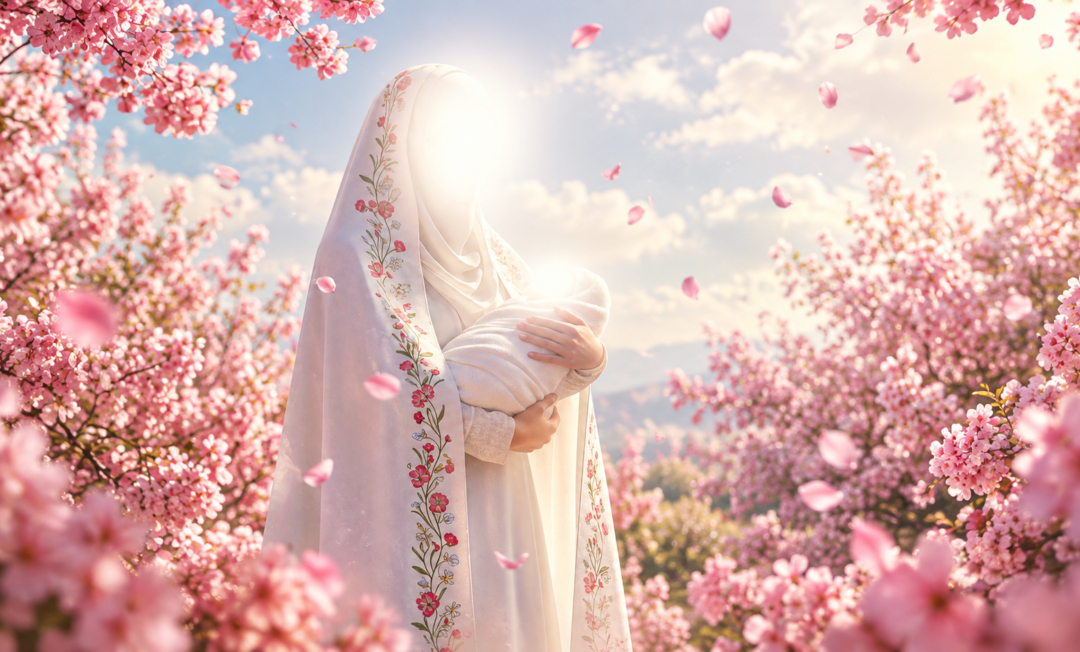
The women surrounded Khadijah, and Fatimah al-Zahra was born.
A Light That Filled the House
Traditional narrations describe Fatimah’s birth as being accompanied by extraordinary signs.
According to the account, when Fatimah was born, a radiant light emerged from her and illuminated the house. The narration describes this light as spreading far beyond the home and reaching toward the eastern and western horizons.
Ten heavenly maidens are then said to have appeared, carrying vessels containing water from Paradise. Fatimah was washed with this blessed water and wrapped in two white garments described as purer than milk and more fragrant than musk and amber.
The narration then describes Fatimah speaking immediately after her birth.
She testified to the oneness of God and to the prophethood of her father, Muhammad. She also spoke of Imam Ali as the master of the successors and referred to her children as the leaders among the descendants.
She then greeted the women who had assisted Khadijah and called each of them by name.
According to the narration, the women rejoiced at her birth and gave Khadijah glad tidings concerning the blessed child and her future descendants.
Khadijah then took her daughter into her arms, embraced her, and nursed her.
Fatimah’s Extraordinary Character
Traditional reports also emphasize that Fatimah al-Zahra developed faster than other children and possessed exceptional qualities from a very young age.
She was raised in the household of the Prophet Muhammad, surrounded by revelation, worship, sacrifice, and the earliest struggles of the Muslim community.
Her upbringing was therefore unlike that of an ordinary child.
She witnessed the dedication of her mother, Khadijah, and the perseverance of her father during the most difficult years of the Prophet’s mission. These experiences helped shape the character of the woman who would later become one of the most revered figures in Islamic history.
The Prophet’s love and respect for Fatimah were also exceptional. His relationship with her went beyond ordinary parental affection and reflected the profound spiritual status attributed to her within the Islamic tradition of the Ahl al-Bayt.
The End of Female Infanticide
The birth of Fatimah also carries a powerful symbolic meaning in Islamic history.
Pre-Islamic Arabia was marked by numerous social injustices, including the practice of burying some infant girls alive. The Qur’an strongly condemned this practice and affirmed the dignity and value of human life.
Fatimah was born into this historical environment and became, in Islamic memory, a powerful symbol of the honor and dignity of daughters.
At the same time, some of the Prophet’s opponents mocked him by calling him abtar, claiming that he had no surviving son who could continue his lineage.
The birth of Fatimah ultimately gave a profound answer to that claim.
She was not merely the daughter of Prophet Muhammad. She became the mother of a lineage through which the Prophet’s descendants continued for generations.
For Shi’a Muslims in particular, Fatimah is regarded as the central link through which the Prophet’s family continued, including the line of the Imams and, ultimately, the awaited Imam al-Mahdi.
Fatimah al-Zahra: A Blessed Legacy
The birth of Fatimah al-Zahra was followed by a life of extraordinary spiritual significance.
She was the daughter of Prophet Muhammad, the daughter of Khadijah, the wife of Imam Ali, and the mother of Hasan and Husayn. Through her, the lineage of the Prophet continued and the household of the Ahl al-Bayt gained one of its most revered figures.
Her birth therefore represents far more than the arrival of a child. In Islamic tradition, it marks the beginning of the life of a woman whose faith, character, sacrifice, knowledge, and devotion would leave an enduring mark on Islamic history.
For millions of Muslims, Fatimah al-Zahra remains a symbol of purity, faith, courage, sacrifice, and devotion to Allah.
Her blessed birth in Makkah is remembered as the beginning of a remarkable life and an extraordinary legacy that continues to inspire Muslims across generations.