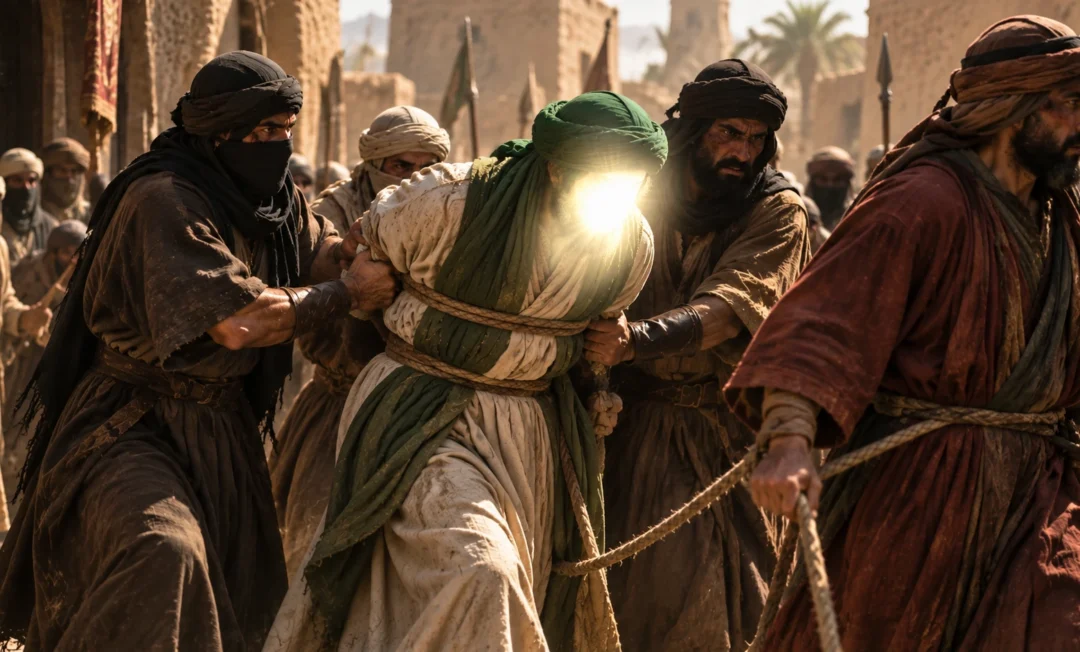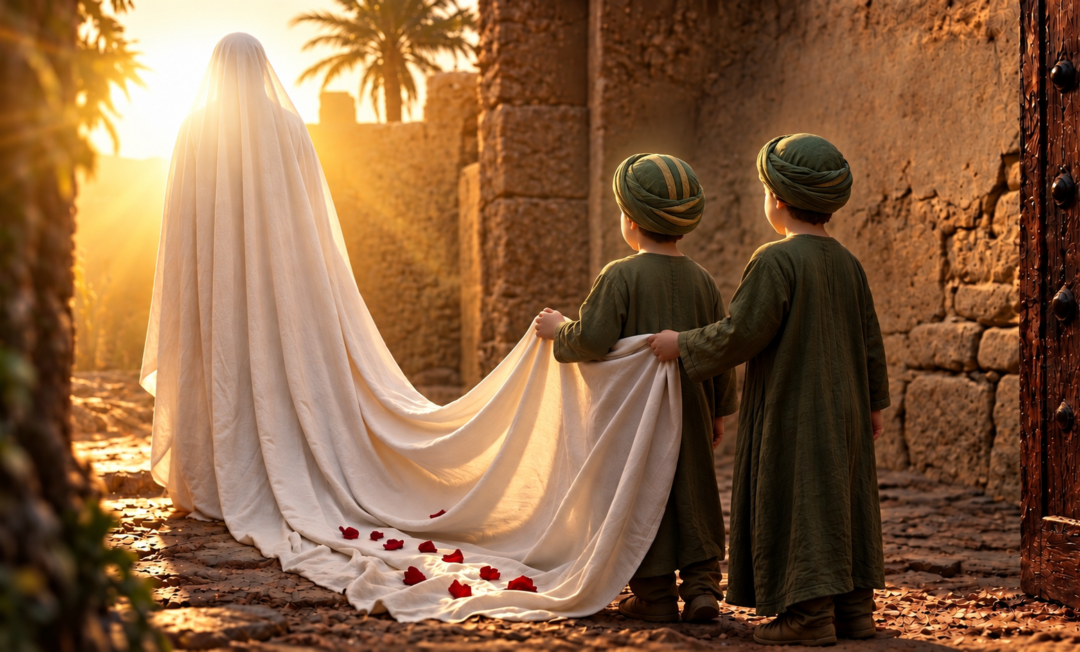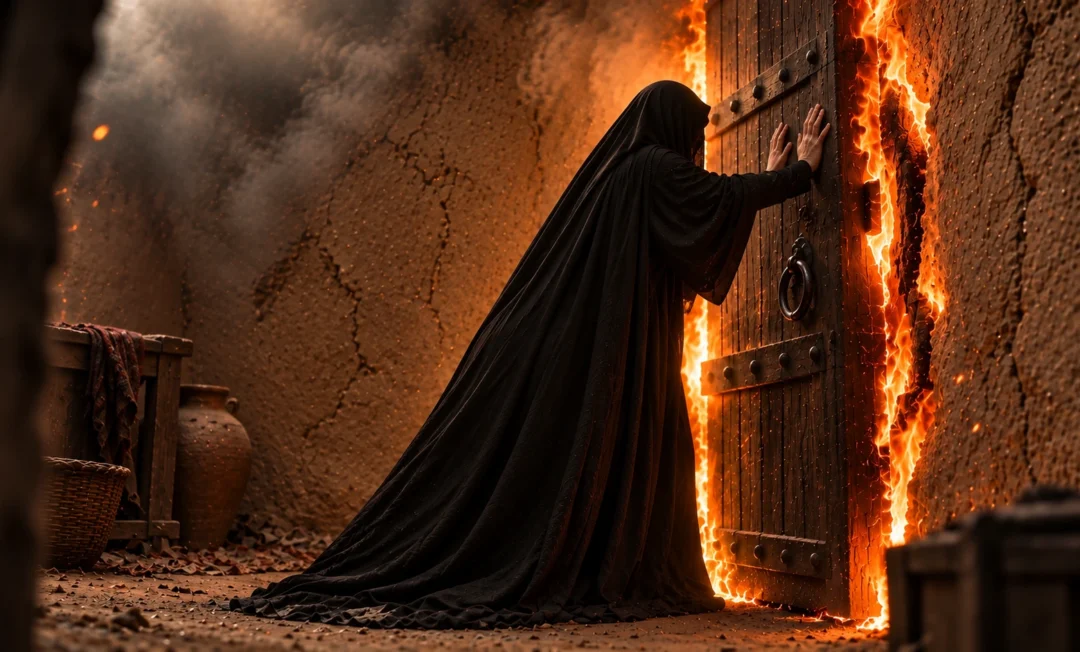


The Last Farewell of Fatimah is one of the most sorrowful moments reported in the history of the Ahl al-Bayt. According to Shi’a narrations, Fatimah al-Zahra سلاماللهعلیها spent her final hours preparing to meet her father, the Messenger of Allah ﷺ, making her final wishes known to Imam Ali عليهالسلام, and saying a heartbreaking farewell to her children.
At that time, Fatimah had already endured a period of illness and suffering. As her condition worsened, she became increasingly aware that her life was drawing to an end. Yet even during those final hours, her thoughts remained closely connected to her family, particularly her young children Hasan and Husayn علیهماالسلام.
The Final Conversation Between Fatimah and Imam Ali
It is narrated that on the day of Fatimah’s passing, Imam Ali عليهالسلام returned home after performing the noon prayer. On the way, he encountered the women of the household while they were weeping and distressed. When he asked what had happened, they urged him to hurry to his cousin and wife, Fatimah, because her condition had become extremely serious.
Imam Ali immediately went to her room and found Fatimah سلاماللهعلیها lying on her bed and moving from side to side because of her severe pain. He removed his cloak and turban, approached her and placed her head in his lap. He called out to her several times, addressing her as the daughter of Muhammad Mustafa ﷺ and as the daughter of the Messenger of Allah, but at first she gave no response.
Eventually, Fatimah opened her eyes and began to weep when she saw Ali. Imam Ali also wept and asked her what was troubling her. Fatimah told him that she could now see death approaching and that there was no way to escape it.
She then began speaking to him about their children. She reminded Ali that Hasan and Husayn had already lost their grandfather, the Messenger of Allah ﷺ, and that they were now about to lose their mother as well. She expressed her deep concern for their future and asked Ali to look after them.
According to the narration, Fatimah also spoke about the suffering that would come upon her descendants and particularly referred to the future tragedy of Karbala. She asked Ali to remember her children and to weep for her and for those among her descendants who would face suffering and death.
She then explained to Imam Ali why she knew that her final hours had arrived. She told him that she had seen her father, the Messenger of Allah ﷺ, in a dream. He had called her toward him and told her that he was longing for her and that she would join him that night.
Fatimah said that her father had always spoken the truth and that she was certain the promised meeting would take place. She then gave Ali her final instructions concerning her burial.
She told him that when she recited Surah Ya-Sin, he should understand that her death was near. She asked him to wash her body himself, to keep her covered during the washing, and to have only her close family members pray over her. Most importantly, she asked him to bury her during the night, as she said her father had instructed her.
These final instructions became an important part of the events that followed her death. Her wish for a private and nighttime burial was respected, and her funeral was not conducted as a public ceremony.
The Last Moments With Hasan and Husayn
Fatimah also had another final responsibility before her departure: preparing for her children.
In another narration, she called Asma bint Umays and asked her to bring the remaining hanut of the Messenger of Allah ﷺ. She then covered herself with her garment and told Asma to wait for a short time before calling her. If she responded, she was still alive; if there was no response, Asma was to understand that Fatimah had gone to meet her father.
After waiting, Asma called her but heard no answer. She called again, addressing her by her relationship to the Prophet ﷺ, yet still received no response. When she lifted the covering, she realized that Fatimah had passed away.
Asma remained beside her and asked Fatimah to convey her greetings to the Messenger of Allah ﷺ when she reached him.
At that moment, Hasan and Husayn علیهماالسلام entered the house and asked where their mother was. They were told that she had passed away.
The two children could hardly accept what they had heard. They threw themselves upon their mother’s body and began to weep. Hasan called out to his mother and begged her to speak to him before his own soul departed because of the pain of losing her.
Husayn also came to his mother, held her feet and kissed them. He called himself by name and begged her to speak to him before grief destroyed him.
This was the final farewell between Fatimah and her two sons. They were still children, and the loss was especially painful because the death of their grandfather, the Prophet ﷺ, had occurred only a short time earlier. Now the same family was facing another devastating separation.
Asma then instructed Hasan and Husayn to go to their father and tell him what had happened.
The two children left the house and went toward the mosque while crying. When they approached the mosque, their grief attracted the attention of those present. Some companions approached them and asked why they were weeping. Hasan and Husayn answered that their mother had passed away.
When Imam Ali received the news, the pain was overwhelming. According to the narration, he fell to the ground from the intensity of his grief. When he recovered, he expressed one of the most painful sentiments associated with the loss of Fatimah:
“O daughter of Muhammad! You were my comfort after the tragedy of the Messenger of Allah. After you, from whom can I seek comfort?”
These words reveal the extraordinary place Fatimah held in Ali’s life. She was not only his wife but also the daughter of the Prophet ﷺ, the mother of his children and the person who had shared his deepest sorrows after the death of the Messenger of Allah.
The Night of Washing and Burial
After Fatimah’s death, the people of Medina gathered around her home, expecting that her body would be brought outside for a public funeral. But the funeral did not take place as they expected. The people were eventually told to disperse because the burial had been delayed.
When night came, Imam Ali عليهالسلام began preparing his wife for burial according to her wishes.
The washing of Fatimah was carried out privately. According to the narration, those present included her children Hasan, Husayn, Zaynab and Umm Kulthum, as well as Fiddah and Asma bint Umays. Imam Ali himself took responsibility for washing her body.
One narration records Imam Ali saying that he washed Fatimah while she remained in her garment and that he found her pure and purified. He then used the remaining hanut of the Prophet ﷺ before shrouding her.
When he was ready to tie the shroud, Ali called the members of the family and said:
“Come and take your provision from your mother, for this is the time of separation, and our meeting will be in Paradise.”
Hasan and Husayn came forward, crying and lamenting their separation from their mother. They asked her to convey their greetings to their grandfather, the Messenger of Allah ﷺ, and to tell him that they had been left orphaned in this world after his death.
Then another deeply emotional moment is narrated.
Imam Ali stated that Fatimah cried out in profound grief, stretched out her hands and drew Hasan and Husayn toward her chest, holding them for a long time. A heavenly voice was then heard telling Ali to lift the two children away from their mother because their grief had caused the angels of the heavens to weep.
Ali then lifted Hasan and Husayn from their mother’s chest.
The scene marks the final earthly embrace between Fatimah and her children. After this, the preparations for the burial continued.
A small group of close companions took part in the funeral prayer, and Fatimah was buried during the night in accordance with her will. Her burial was kept private, and the location of her grave was not openly identified. Some reports further state that measures were taken to prevent the exact grave from being recognized.
Imam Ali’s Words After the Burial
When the burial was completed, Imam Ali turned toward the grave of the Messenger of Allah ﷺ and addressed him with a heart overwhelmed by sorrow.
He said:
“Peace be upon you, O Messenger of Allah, from me and from your daughter who has come to meet you and now lies buried beside you.”
He then spoke of how his patience had reached its limit because of the loss of Fatimah. He recalled the pain of losing the Prophet and explained that although he had endured that earlier separation, the death of Fatimah had brought another unbearable grief into his life.
He went on to express his complaint about what had happened after the Prophet’s death and said that his daughter would soon inform her father about what had happened to her. He asked the Prophet to hear her account and learn from her what the community had done after his departure.
The words attributed to Imam Ali are filled with grief, but they also convey the seriousness with which he viewed the events surrounding Fatimah’s final days.
He described his sorrow as something that would remain with him, his nights as filled with sleeplessness and his heart as carrying an enduring wound.
The grief did not end at the grave.
Some sources also preserve poetry attributed to Imam Ali in which he reflects on the painful reality of losing one beloved person after another and the fact that earthly companionship cannot last forever.
The Hidden Grave of Fatimah
The story of Fatimah did not end with her burial.
One of the most enduring questions associated with her death is the location of her grave. Because she was buried at night and the location was deliberately concealed, later generations did not inherit a single universally agreed location.
Various views have been reported. Some have placed her grave in al-Baqi’, while others have mentioned the house of Aqil, the Rawdah of the Prophet ﷺ or Fatimah’s own house.
Among Shi’a scholars, a number of important reports support the view that Fatimah was buried in her own house or in the area beside the resting place of the Prophet ﷺ. Narrations attributed to Imam al-Sadiq, Imam al-Rida and Imam Ali al-Hadi علیهمالسلام identify her burial place with her house and its surrounding area. Scholars including Shaykh al-Saduq, Allamah al-Hilli, Allamah al-Majlisi and Shaykh al-Tusi are also associated with views concerning her burial in this location.
One of the arguments cited in support of this view is the statement attributed to Imam Ali after the burial, when he addressed the Prophet and described Fatimah as having come to him and being buried beside him.
According to these reports, Fatimah’s house was later incorporated into the expanded area of the Prophet’s Mosque, which is why some accounts connect the location of her grave with the mosque today.
The hidden grave has therefore remained one of the enduring mysteries associated with Fatimah al-Zahra. Within Shi’a tradition, the concealment of her burial place is closely connected with her final wishes and with the circumstances surrounding the end of her life.