
One of the questions raised about the events following the death of the Messenger of Allah ﷺ is this: If Imam Ali ibn Abi Talib عليه السلام was one of the bravest and strongest figures in Islamic history, why did he not defend Fatimah al-Zahra سلام الله علیها in the way people would normally expect when her home was attacked?
This question becomes even more important when we remember Imam Ali’s life during the time of the Prophet ﷺ. He was the person who stood beside the Messenger of Allah in the most difficult battles, confronted powerful enemies and defended the Prophet at critical moments. It is therefore natural for many people to ask why that same Ali عليه السلام remained patient when events were taking place against Fatimah, the beloved daughter of the Prophet and his own wife.
To answer this question, however, one important point must first be understood: according to Shi’a sources, it is not accurate to say that Imam Ali عليه السلام simply did nothing. In some Shi’a narrations, he is described as reacting when his family was threatened and confronting those who entered or attempted to enter his home. However, he did not continue that confrontation until it became a wider armed uprising. The real issue, therefore, is not whether Imam Ali had the courage to defend Fatimah, but why he did not turn that confrontation into a general armed struggle.
Imam Ali Was Not Indifferent
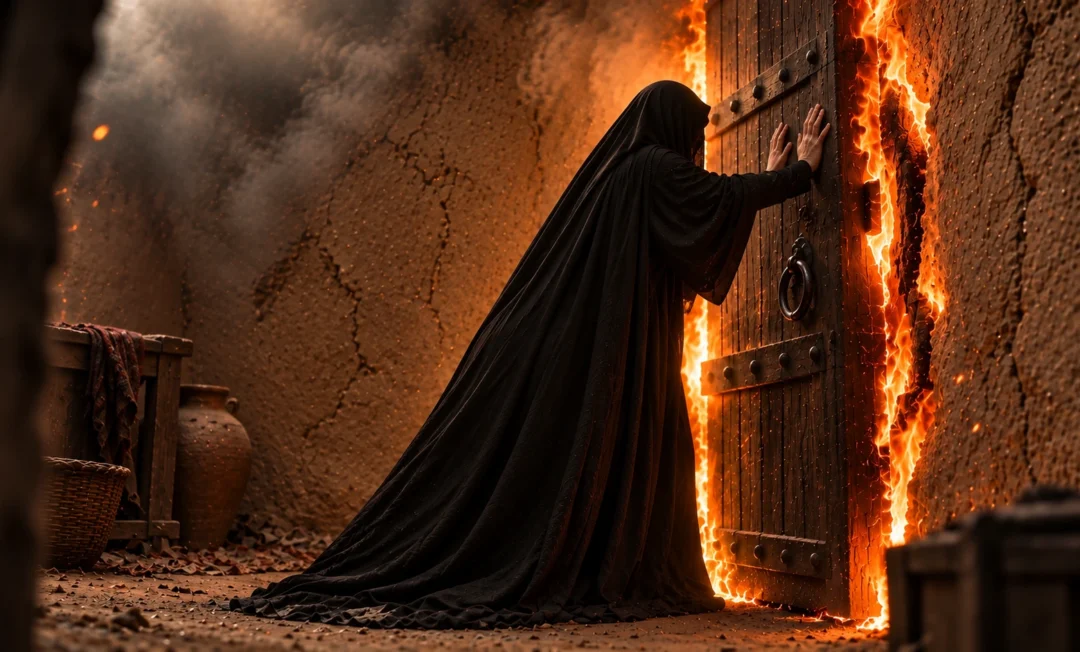
One of the important reports concerning this event is the narration attributed to Sulaym ibn Qays al-Hilali. According to this narration, when the confrontation at the house reached the point where Fatimah سلام الله علیها was threatened, Imam Ali عليه السلام suddenly rose and confronted Umar.
The narration describes Ali taking Umar by the collar, pulling him to the ground and striking him on the nose and neck. It further states that Imam Ali intended to kill him, but then remembered the words and instructions of the Messenger of Allah ﷺ and stopped.
This account is important because it presents a very different picture from the claim that Imam Ali simply stood by and watched while his family was threatened.
According to this narration, he did respond.
He confronted the attacker and demonstrated that he was fully capable of doing so. What he did not do was continue the confrontation until it developed into a much larger conflict.
The same report records Imam Ali عليه السلام reminding Umar that if it were not for the Book of Allah and the covenant he had made with the Messenger of Allah ﷺ, Umar would not have been able to enter his home.
The same report was also transmitted by al-Alusi, a well-known Sunni commentator, from Shi’a sources. His account likewise mentions the confrontation and Imam Ali’s physical reaction.
Therefore, the first point that must be understood is the difference between not responding and not launching a broader armed uprising. According to Shi’a sources, Imam Ali did not lack a reaction; rather, he stopped short of turning that reaction into a prolonged civil conflict.
Why Did Imam Ali Not Continue With an Armed Uprising?
To understand this decision, we need to look at the social and political circumstances in Medina after the death of the Prophet ﷺ. Imam Ali عليه السلام had no shortage of courage or military ability, but a successful armed uprising cannot be achieved by the bravery of one individual alone. Such a movement requires supporters, social strength and people who are prepared to stand with their leader through the consequences of a major confrontation.
According to reports found in Shi’a sources, Imam Ali did not have enough such supporters at that time. Some reports state that he wished he had forty determined men who would stand with him. Another narration says that when he sought assistance from the Muhajirun and Ansar, only a very small number responded positively, including Salman, Abu Dharr, Miqdad and al-Zubayr.
This was an important factor in his decision. Personal courage can enable a person to stand against several opponents, but a political and military uprising requires a much broader base of support. If such support does not exist, the result of an armed confrontation may be the death of the available supporters, the defeat of the movement and the spread of division among Muslims.
The situation of the Muslim community at that time made the matter even more serious. Islam had not yet become firmly established in every part of Arabia, and some tribes that had accepted Islam during the final years of the Prophet’s life turned away after his death. Individuals such as Musaylimah, Tulayhah and Sajah also emerged and gathered followers around their claims. At the same time, there was concern about external enemies and particularly the Romans.
In such circumstances, Imam Ali عليه السلام was facing two major realities at once. On one side, he saw the rights of himself and the Ahl al-Bayt being denied and witnessed what he regarded as oppression against his family. On the other side, he had to consider what would happen to the Muslim community if an armed conflict began at the very center of Medina.
This is the background to Imam Ali’s famous words in the Sermon of al-Shaqshaqiyyah in Nahj al-Balagha. He describes the difficult choice before him: whether to rise with limited strength or endure the dark circumstances surrounding him. He ultimately chose patience because he regarded it as closer to wisdom. Yet he describes that patience through extremely painful imagery, comparing his condition to someone with a thorn in his eye and a bone in his throat while watching what he regarded as his rightful inheritance being taken away.
These words show that his patience was not presented as comfort or satisfaction. It was an extremely difficult decision made under painful circumstances.
Why Did Imam Ali Not Participate in the Wars During the Caliphs’ Rule?
Imam Ali’s conduct after the Prophet’s death was not limited to the events surrounding his home. Another important point discussed in Shi’a sources is his lack of direct participation in the major military campaigns during the rule of the first caliphs.
This question becomes especially significant because Imam Ali had been one of the most active warriors during the lifetime of the Prophet ﷺ. In battles such as Uhud and Hunayn, when many Muslims left the battlefield, he remained near the Messenger of Allah and defended him. His military courage was therefore already well known.
So why did the same Ali عليه السلام not take the same role in the wars fought during the rule of the caliphs?
From the Shi’a perspective, this was connected to the same broader policy of Imam Ali. He distinguished between protecting Islam and giving political legitimacy to a leadership arrangement that he believed had taken the rights of the Ahl al-Bayt.
He did not want Islam to become weak, nor did he wish its enemies to benefit from Muslim division. At the same time, he did not place his military power at the service of a political order that he believed had been established against the rightful position of the Ahl al-Bayt.
This distinction is important because his absence from those military campaigns cannot simply be explained by a loss of courage or a desire to avoid struggle.
The man who had fought at the side of the Prophet ﷺ had already demonstrated that he did not fear the battlefield.
The issue was whether every battle was beneficial to Islam and whether his participation would strengthen the religion or simply strengthen a political order with which he disagreed.
The same argument can be seen in the fifth sermon of Nahj al-Balagha. When Abu Sufyan attempted to take advantage of the political crisis by offering support to Imam Ali for fighting Abu Bakr, Imam Ali rejected the attempt. He stated that if he spoke, people would accuse him of seeking political power, while if he remained silent, they would claim that he feared death. He then made it clear that fear of death could not explain his conduct, recalling his long history of facing death in battle.
His words demonstrate that silence was not caused by fear.
It was a deliberate decision.
The Prophet’s Reported Instruction and the Example of Harun
One of the most important explanations in Shi’a sources comes from a narration attributed to Sulaym ibn Qays concerning the Prophet’s instructions to Imam Ali.
According to this report, the Messenger of Allah ﷺ warned Ali that after his death he would face opposition from Quraysh and suffer injustice at their hands. He then gave him guidance according to the circumstances he would face.
If Ali found sufficient supporters, he should fight those who opposed him.
But if he did not find enough supporters, he should remain patient, restrain himself and not put himself into destruction. The narration then refers to the example of Harun in relation to Musa.
This report is particularly important within the Shi’a understanding because it gives a direct explanation for why Imam Ali’s conduct changed according to the circumstances.
The instruction was not simply to fight under every condition.
It was to fight when there was sufficient support and to exercise patience when such support was absent.
This helps explain why the same Imam Ali who had fought fearlessly during the Prophet’s lifetime could later choose not to begin a large armed conflict in Medina.
His courage had not changed.
The circumstances had changed.
Did Patience Mean That Imam Ali Accepted What Happened?
Another misunderstanding is to assume that Imam Ali’s patience meant that he accepted the political events that followed the Prophet’s death.
According to Shi’a sources, this was not the case.
The disagreements between the Ahl al-Bayt and the political leadership continued in different forms. Among the most well-known disputes was the issue of Fadak and the question of inheritance. The material discussed here also cites the well-known report in Sahih al-Bukhari that Fatimah became angry with Abu Bakr and remained separated from him until her death.
Shi’a sources also preserve reports concerning Imam Ali’s objections to the political situation and his position regarding the rights of the Ahl al-Bayt.
Therefore, patience should not be confused with approval.
A person can oppose a political situation while also deciding that an armed response would produce consequences that are even more dangerous.
This is how the Shi’a tradition understands Imam Ali’s conduct during this period.
Why Did He Not Seek Revenge?
This naturally leads to another question: if Imam Ali believed that his family had been wronged, why did he not immediately seek revenge?
The answer lies in the consequences of such an action.
If he had killed leading political figures at that moment, the event would not necessarily have ended with one confrontation. Retaliation could have followed, tribes might have taken sides and the dispute could have turned into a prolonged internal war.
The issue was therefore larger than a personal dispute between individuals.
It concerned the future of the Muslim community.
According to the Shi’a interpretation, Imam Ali accepted an extremely painful personal cost rather than allow his response to become the beginning of a wider conflict that could weaken the entire Muslim community.
This does not make the suffering of Fatimah less serious.
It explains why Imam Ali did not respond to that suffering through unrestricted military action.
Was Imam Ali Too Weak to Fight?
The answer given in Shi’a sources is no.
The report attributed to Sulaym ibn Qays describes Imam Ali physically confronting Umar and overpowering him before stopping because of the Prophet’s reported instruction.
His own words in Nahj al-Balagha also reject the idea that fear of death was the reason for his restraint. He explicitly recalls his familiarity with death and his long history of confronting it.
Therefore, physical weakness does not provide the explanation.
The more important issue was the absence of the social and political conditions necessary for a successful armed struggle.
Conclusion
Why did Imam Ali not defend Fatimah?
According to Shi’a sources, the question becomes clearer when we distinguish between defending his family during an immediate confrontation and launching a wider armed uprising.
Reports describe Imam Ali reacting when Fatimah was threatened and confronting Umar before stopping because of the covenant and instruction he had received from the Messenger of Allah ﷺ.
The larger struggle was different. Imam Ali did not have enough supporters to launch a successful uprising, while the Muslim community was already facing serious internal instability and external threats.
The reported instruction of the Prophet ﷺ was also clear within this tradition: if Ali had sufficient supporters, he should fight; if he did not, he should remain patient and restrain himself.
His later conduct, including his limited military role during the rule of the first caliphs, is also understood within this wider approach. He did not abandon Islam, but neither did he place his military strength behind a political order that he believed had denied the rights of the Ahl al-Bayt.
Therefore, according to the Shi’a understanding, Imam Ali’s patience was not caused by fear, weakness or indifference toward Fatimah.
He was the same man whose courage had already been demonstrated repeatedly on the battlefield.
What changed was not his courage, but the circumstances in which he had to use it.
At a time when he lacked sufficient supporters and believed that an armed conflict could seriously endanger the Muslim community, he chose patience over a wider uprising. For him, this patience was not an easy retreat. It was a painful decision made while witnessing events that deeply affected him and his family.
His sword had already demonstrated his courage.
His patience demonstrated his willingness to endure personal suffering when he believed that doing so would protect the greater interests of Islam.