

What makes a person truly strong?
Today, strength is often associated with confidence, independence, money, influence, or the ability to handle everything alone. Social media can add another layer of pressure: look successful, stay confident, achieve more, and never appear vulnerable.
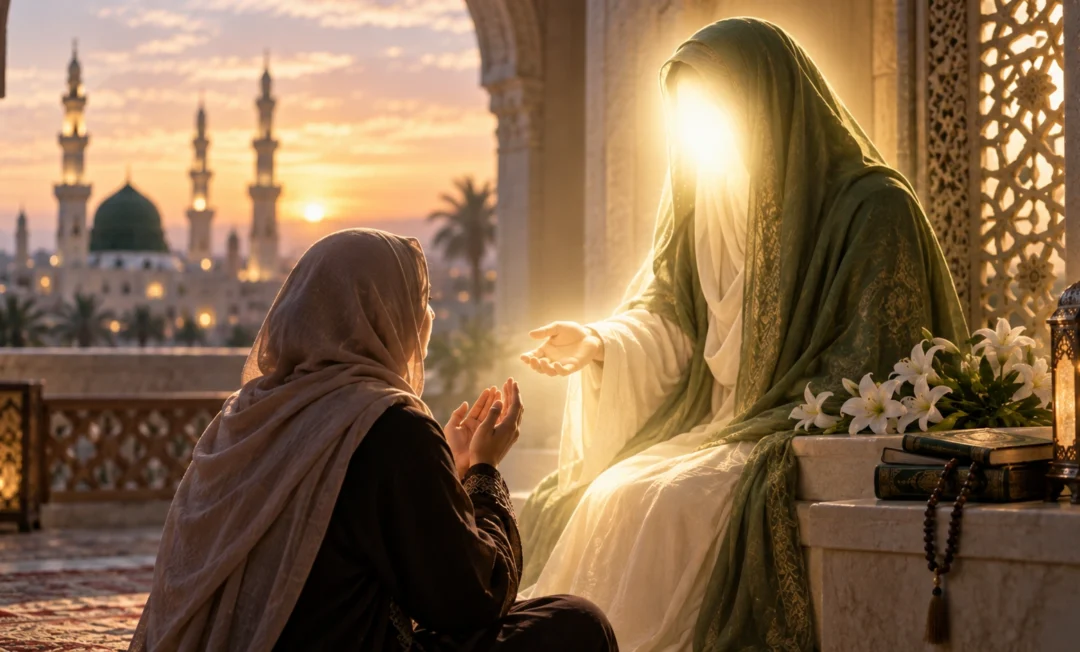
Fatimah al-Zahra offers a very different picture of strength.
Remembered as the daughter of Prophet Muhammad, she lived in seventh-century Arabia through hardship, loss, family responsibilities, and major changes in her community. Yet the qualities associated with her life—courage, compassion, patience, generosity, and resilience—were rooted in something deeper than personal ability.
Her strength began with faith in God.
That foundation changes the way her life can be understood. Her patience was connected to trust in God. Her courage grew from conviction. Her generosity came from believing that worldly possessions were not the highest form of security. Her worship gave her a source of strength beyond herself.
For anyone discovering Fatimah al-Zahra for the first time, her life raises a question that feels remarkably relevant today:
What kind of strength allows a person to remain steady when life is no longer under their control?
The Strength That Comes From Faith
Fatimah’s life cannot really be separated from her relationship with God.
Faith was not simply an idea she accepted. It shaped how she lived, how she endured difficulty, and how she understood her responsibilities.
There is a major difference between believing, I must be strong enough to handle everything myself, and believing, I will do everything I can, but I trust God with what lies beyond my control.
The first approach can become exhausting. The second creates room for humility, patience, and hope.
This does not mean faith makes hardship disappear. It means hardship does not have the final word.
That may be one of the most important lessons for a generation living with anxiety, uncertainty, and constant pressure. Sometimes we do not become stronger by gaining more control. We become stronger by developing the faith to face what we cannot control.
Strength Is Not About Controlling Everything
Modern life often rewards people who appear to have everything together.
But no one can control every outcome. Careers change. Relationships become complicated. Plans fail. People get sick, leave, disappoint us, or misunderstand us. Unexpected events can change a person’s life overnight.
Fatimah lived through circumstances she could not simply fix. Her strength was shown in how she remained anchored despite them.
That is a different kind of courage: doing what is right while accepting that the result is ultimately not yours to command.
You Do Not Need a Perfect Life to Have a Meaningful One
Fatimah lived simply and experienced periods of hardship. Her life was not built around comfort, luxury, or public recognition.
That matters in an age when people are constantly shown what they supposedly need to be happy.
A larger house. A better career. More travel. More followers. A more impressive lifestyle.
The comparison never ends.
Fatimah’s example points somewhere quieter. A meaningful life can be simple. Its value can come from faith, relationships, service, character, and purpose rather than appearance.
You do not have to build a perfect life before your life can have meaning.
Stop Turning Your Life Into a Competition
One of the biggest pressures facing younger generations is comparison.
People can now see hundreds of carefully selected versions of other people’s lives every day. Someone else’s success can make your own progress feel small. Someone else’s appearance can make you question your own. Someone else’s relationship can make yours seem inadequate.
Faith offers another way of measuring life.
Instead of constantly asking, How do I compare with everyone else?, a person can ask, Am I living according to the values I believe in? Am I becoming a better person? Am I closer to God? Am I useful to the people around me?
Those questions lead somewhere more stable.
Giving Can Make You Stronger
Traditional accounts remember Fatimah as a generous person, including moments when she gave despite having little herself.
Her example challenges a common assumption: that generosity belongs to people who already have enough.
Giving can involve money, but it can also mean giving your time, attention, knowledge, encouragement, forgiveness, or care.
Faith changes the meaning of generosity. When a person sees what they have as a trust from God rather than the foundation of their identity, holding on to everything becomes less important.
Generosity can become a source of freedom.
Courage Sometimes Means Speaking Up
Strength is often imagined as physical power or a forceful personality.
But courage can also be found in words.
Fatimah is remembered in Islamic tradition for speaking with conviction about matters she considered important. Her example shows that dignity does not require silence.
There are moments in modern life when staying quiet is easier. You may see something unfair. You may disagree with someone you respect. Someone you care about may need you to defend them.
Speaking with honesty and respect can take real courage.
Faith gives that courage a foundation. When your principles come from something deeper than popularity, you become less dependent on other people’s approval.
Softness Is Not Weakness
The modern world can sometimes teach people to protect themselves by becoming emotionally hard.
Be less caring. Expect less from people. Do not become too attached. Never show vulnerability.
Yet Fatimah’s legacy brings tenderness and strength together.
Compassion, affection, generosity, and care for others did not prevent courage. They existed alongside it.
That is an important lesson for everyone, especially in a culture where emotional hardness can sometimes be mistaken for confidence.
A person does not have to become cold to become strong.
Protect Your Inner Life
There is another challenge that Fatimah’s example can help us think about: the loss of inner quiet.
Our lives are filled with notifications, videos, messages, opinions, entertainment, and endless information. Even when nothing is happening around us, something is usually happening on our screens.
Fatimah’s life was deeply connected to prayer, worship, remembrance of God, and reflection.
The broader lesson is valuable even before we enter into theological questions: a person needs an inner life.
Without time for reflection, it becomes difficult to know what you actually believe, what matters to you, and where your life is going.
Faith provides a place of return when the outside world becomes overwhelming.
Choose People, Not Just Performance
Modern culture has become very good at measuring performance.
How much did you accomplish? How productive were you? How much money did you make? How successful do you appear?
But human beings are more than their output.
Fatimah’s story is closely connected with family, marriage, care, responsibility, and relationships. Her life reminds us that being present for other people is also important work.
A person can succeed professionally and still feel deeply alone.
A full calendar is not the same thing as a full life.
Hardship Does Not Have to Define You
Fatimah’s life included grief and difficult circumstances. Yet when people remember her today, they remember far more than the hardships she experienced.
That is an important distinction.
Pain can become part of your story without becoming the whole story.
Resilience does not mean pretending that suffering does not hurt. It means continuing to hold on to faith, principles, and hope even while carrying that pain.
For anyone dealing with loss, uncertainty, disappointment, or exhaustion, this is a powerful idea: what happens to you matters, but it does not have to determine who you become.
Faith Gives Hardship a Different Meaning
Perhaps this is where Fatimah’s example becomes most different from ordinary ideas about resilience.
Many modern messages encourage people to believe in themselves: You are strong. You can do anything. You can overcome anything.
There is value in confidence, but confidence alone has limits.
Fatimah’s model begins somewhere else.
She trusted God.
That trust did not remove responsibility. She still faced difficulties, cared for her family, fulfilled her duties, worshipped, gave, spoke, and endured. But she did not have to believe that everything depended on her own power.
For a believer, this can be profoundly freeing.
You can work hard without believing you control every result.
You can care deeply without being destroyed by uncertainty.
You can face fear without believing you are alone.
You can experience loss without believing your life has lost all meaning.
That is the kind of strength faith can create.
A Different Definition of Success
What if success were measured differently?
Not only by income, appearance, popularity, or status, but by qualities such as faith, integrity, courage, compassion, wisdom, loyalty, and the ability to remain grounded under pressure.
Fatimah al-Zahra’s legacy invites that kind of rethinking.
Her life suggests that a person’s value is not determined by how much attention they receive or how impressive their life appears.
Sometimes the strongest person in the room is the one who quietly knows what matters, remains faithful to it, and does not need the world to applaud.
Why Her Story Still Matters
You do not need to know every detail of early Islamic history to understand why Fatimah al-Zahra continues to matter.
Her story brings together questions that every generation eventually faces:
How do you remain yourself when the world pressures you to become someone else?
How do you face hardship without losing hope?
How do you care for people without losing your own principles?
How do you build a meaningful life when success is constantly being redefined?
And perhaps most importantly:
Where does your strength come from when your own strength is not enough?
For Fatimah, the answer began with God.
Her courage, patience, generosity, and resilience were not isolated personality traits. They were connected to faith.
A Different Kind of Strength
The world may tell us that strength means becoming independent enough to need no one, successful enough to impress everyone, and confident enough to control our lives.
Fatimah al-Zahra offers a deeper picture.
Her strength was rooted in faith—in knowing God, trusting Him, worshipping Him, and remaining committed to what she believed was right even when life became difficult.
That foundation produced courage without arrogance, patience without giving up, generosity without insecurity, and resilience without losing tenderness.
Perhaps this is the kind of strength many people are searching for today.
Not the strength to control everything.
Not the strength to appear invulnerable.
But the strength to trust God, live with purpose, face hardship with patience, care for others, stand for what is right, and remain faithful to what truly matters.