
A Wedding Without Extravagance
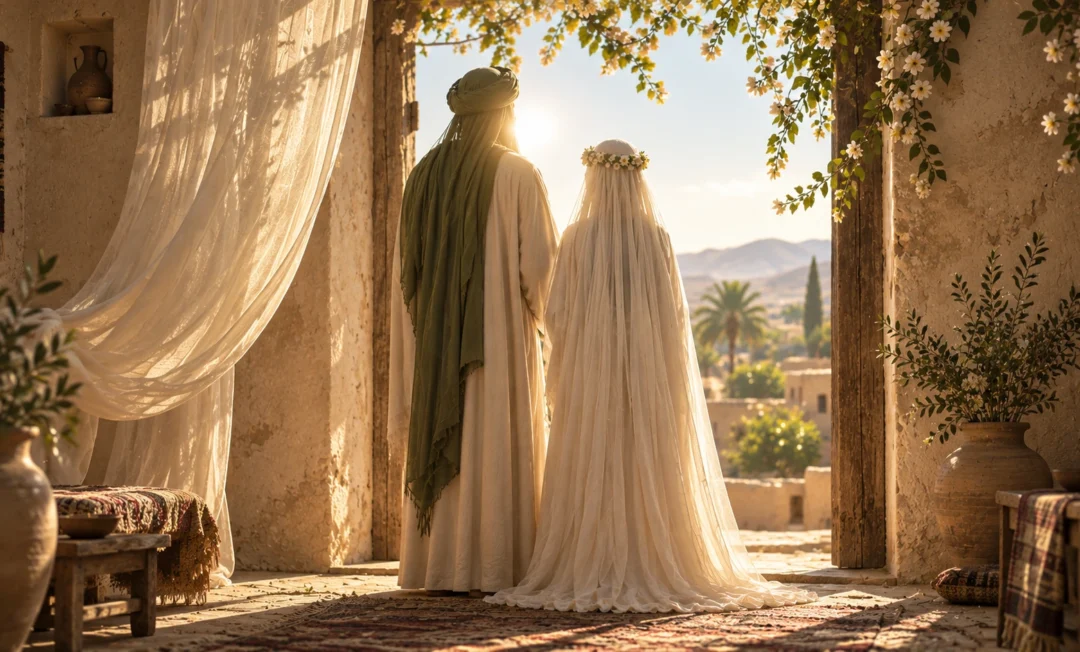
The wedding of Fatimah al-Zahra and Imam Ali (peace be upon them) is remembered for something that may seem surprising today: its simplicity.
Fatimah was the daughter of Prophet Muhammad, yet her wedding was not turned into a display of wealth or social prestige. The preparations were modest, the household goods were limited, and the feast was simple.
The marriage is commonly placed in the second year after the Hijrah, although historical accounts vary over the exact date.
The simplicity of the celebration became one of the most enduring features of its memory.
Preparing the Bride’s Home
About a month after the marriage contract, traditional accounts say that some of the Prophet’s wives asked Ali why Fatimah had not yet moved into his home.
Ali expressed his readiness.
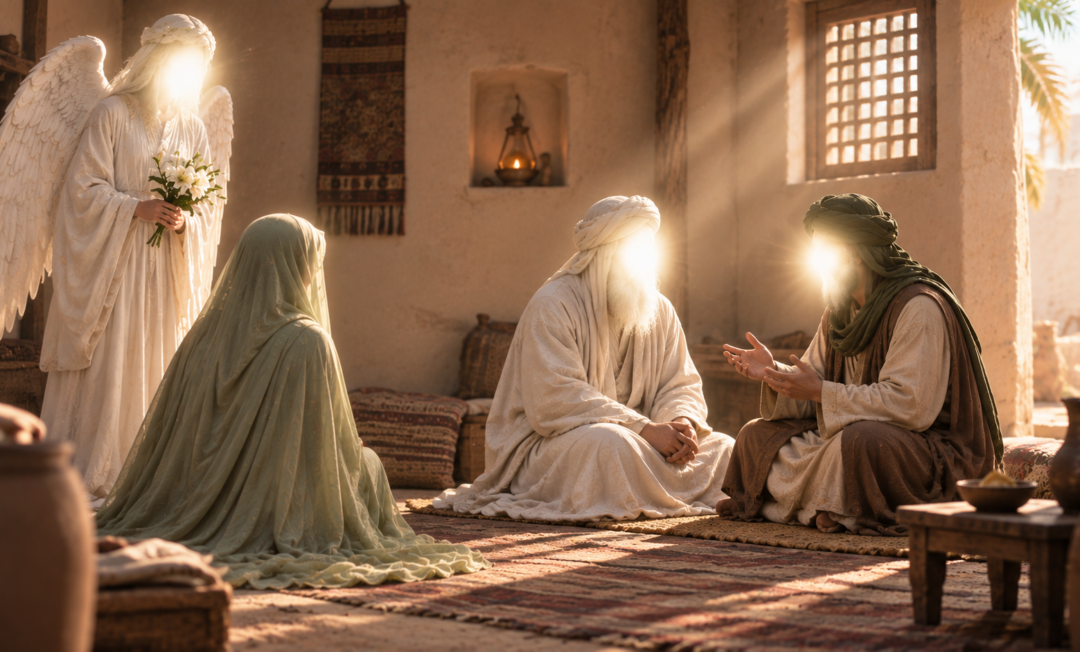
Umm Ayman then approached the Prophet and reminded him that Khadijah, Fatimah’s mother, would have been overjoyed to see her daughter’s wedding. The mention of Khadijah brought tears to the Prophet’s eyes. He remembered the woman who had believed in him when others rejected him and supported the early growth of Islam with her wealth.
The Prophet then instructed that a room be prepared for Fatimah.
A Modest Bridal Trousseau
Ali sold his shield, following the Prophet’s instruction, for a sum reported in different sources as 400, 480, or 500 dirhams. The source material identifies the shield as one associated with the tribe of Hatimiyyah and says that some reports name Uthman as the buyer before the shield was returned to Ali.
The money was then used for several purposes connected with the marriage.
Traditional accounts describe part of it being used for the household goods, another portion for perfume, and another for the wedding meal.
The resulting trousseau was remarkably modest.
Among the items listed in the traditional reports are a simple head covering, a length of cloth for a dress, a bed made from wood and palm leaves, four sheep-skin cushions filled with fragrant idhkhir grass, a woolen curtain, a mat, a leather water skin, a small hand mill, a copper basin, a vessel for milking, and a green earthenware water jug.
Other reports add items such as additional pottery, a palm-fiber rope, a leather table covering, and a simple woven rug. The lists differ somewhat from one source to another.
When the belongings were brought before the Prophet, traditional accounts say that he blessed the household and prayed for God’s blessing upon the family.
Preparing the House
Ali had limited housing options after the marriage. Traditional accounts identify the house associated with Harith ibn al-Nu’man as the couple’s first residence before the Prophet later arranged for them to live closer to him.
The home itself was prepared with only what was necessary.
Accounts mention simple items such as a piece of wood from which clothing or a water skin could be hung, a cushion, a water container, and a flour sieve.
There was no effort to create an extravagant setting.
The purpose was simply to create a home in which the newly married couple could begin their life together.
The Wedding Feast
The wedding feast was equally simple.
Traditional reports mention bread, dates, oil, cooked meat, and curd or dried yogurt among the food prepared for the guests.
Some companions contributed what they could. One report says that Sa’d brought a sheep, while others helped according to their means.
The Prophet also participated directly in the preparations.
When Ali was asked to invite the people, he went to the mosque. Seeing the large number of Muslims gathered there, he did not want to invite some and exclude others.
Instead, according to the traditional account, he called out publicly:
“Come to the wedding feast of Fatimah, daughter of Muhammad.”
People then made their way to the gathering.
Food for Everyone
The amount of food seemed insufficient for the number of guests.
Traditional narrations say that the Prophet placed his hand over the food and prayed for God’s blessing.
By the blessing of that prayer, everyone was able to eat and be satisfied, and the food did not run out.
The same account illustrates an important feature of the celebration: the wedding was simple, but it was not mean-spirited or joyless.
There was food, hospitality, community, and celebration.
What was absent was extravagance.
The Wedding Dress Fatimah Gave Away
Perhaps the most memorable story associated with the wedding concerns Fatimah’s dress.
According to a traditional narration, the Prophet had given Fatimah a new garment for her wedding night. When a needy person came asking for clothing, Fatimah first considered giving an older garment.
Then she remembered the Qur’anic principle of giving from what one loves:
“You will never attain righteousness until you spend from what you love.”
— Qur’an 3:92
She therefore gave the needy person her new wedding dress.
She changed into another, older dress instead.
The significance of the story lies in the fact that the dress was not an unwanted spare garment. It was the new dress intended for her wedding night.
That detail has made the story one of the most memorable examples of Fatimah’s generosity and detachment from worldly possessions.
The Bride’s Journey to Ali’s Home
When the time came for Fatimah to leave the Prophet’s house, traditional accounts describe the Prophet calling for his daughter.
Fatimah approached him with modesty and visible emotion.
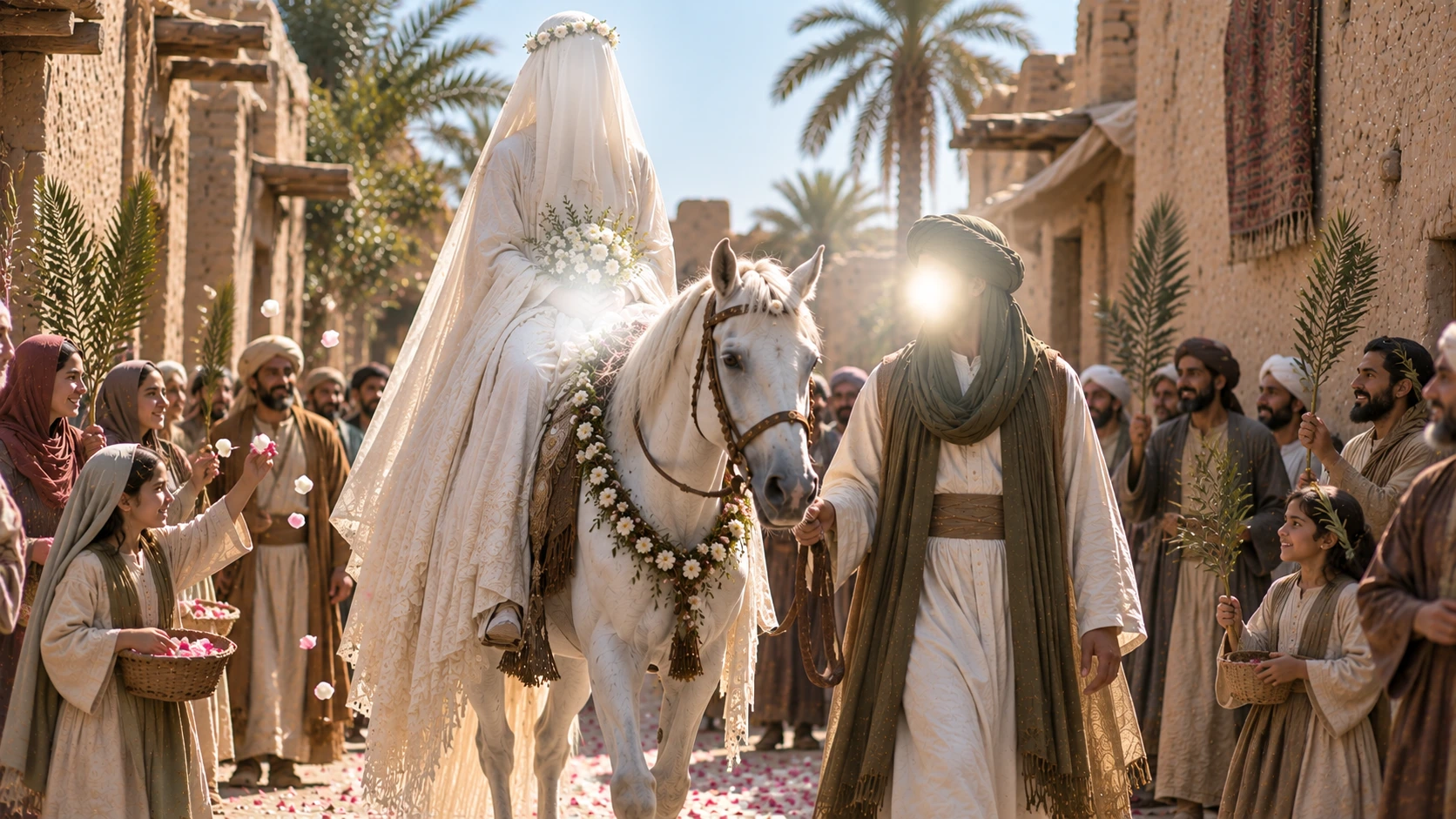
The Prophet comforted her, embraced her, and prepared to accompany her to Ali’s home. Reports differ over the precise animal on which she traveled, but they agree in describing the Prophet personally leading or accompanying the procession.
Women from Banu Hashim and the wider Muslim community accompanied the bride.
Some narrations describe women reciting verses and others responding with praises and takbir.
The procession then reached Ali’s home.
The Heavenly Wedding in Traditional Narrations
Alongside the earthly ceremony, Islamic devotional literature contains accounts describing the marriage in heavenly terms.
Some reports state that an angel conveyed to the Prophet that God had joined Fatimah and Ali in the heavenly realm before the earthly ceremony took place. Other reports describe angels celebrating the marriage.
The source material also records a traditional account in which Gabriel, Mika’il, and large numbers of angels accompanied the wedding procession.
These reports are best understood as part of the spiritual literature surrounding the Ahl al-Bayt.
They express how extraordinary the marriage came to be regarded within Islamic devotional tradition.
A Wedding Remembered for Its Simplicity
The wedding of Fatimah and Ali offers a striking contrast to ceremonies in which the cost of the celebration becomes more important than the marriage itself.
There was no palace, no excessive decoration, and no demand for an elaborate trousseau.
There was a modest home, simple possessions, a communal meal, and a family celebration centered on two people whose faith and character were considered more important than worldly status.
That combination of simplicity and dignity is perhaps the clearest reason why their wedding remains so deeply remembered.