

The home of Fatimah al-Zahra and Imam Ali (peace be upon them) was modest in its possessions, yet rich in faith, affection, sacrifice, and responsibility.
Fatimah was the daughter of Prophet Muhammad (peace and blessings be upon him and his family), and Ali was among the Prophet’s closest companions and members of his household. Their marriage therefore began with an extraordinary spiritual and family background, but their daily life was marked by the realities faced by an ordinary young Muslim family: work, limited resources, children, illness, separation, hardship, and the responsibility of serving others.
What made their home remarkable was not freedom from difficulty. It was the way they faced difficulty together.
Their family life can be understood through several closely connected qualities: faith, tranquility, mutual respect, cooperation, generosity, contentment, and love.
A Home Built on Faith
For Fatimah and Ali, family life was closely connected to worship.
The Qur’an describes marriage as a relationship in which spouses find sakinah, or tranquility, and in which Allah places mawaddah and rahmah—affection and mercy—between them:
“And among His signs is that He created for you spouses from among yourselves so that you may find tranquility in them; and He placed between you affection and mercy.”
— Qur’an 30:21
The source material uses this principle as the foundation for understanding their household: peace within a family does not come from possessions alone, but from the attitudes and actions of the people who live together.
The home of Fatimah and Ali was therefore not simply a place where they ate and slept. It was also a place of prayer, remembrance, Qur’an, charity, and spiritual preparation.
Fatimah maintained a dedicated place for prayer and was known for her devotion and long periods of worship. Ali likewise set aside time and space for worship and Qur’anic recitation. The source describes both of them as creating an atmosphere in which remembrance of Allah was part of the rhythm of family life.
This spiritual atmosphere gave the family an important form of stability.
Hardship still came.
But hardship did not automatically become despair.
A Simple Home With Purpose
The material simplicity of their household is one of the features most often remembered.
Ali’s financial means were limited when the marriage began. His shield was sold toward Fatimah’s mahr, and the remaining resources were used to establish their household.
Traditional accounts describe a modest collection of household necessities: bedding, a mat, cushions, a water skin, a hand mill, and simple vessels.
There was no attempt to turn the home of the Prophet’s daughter into a showcase of wealth.
Yet simplicity did not mean disorder or neglect.
Fatimah carefully managed the household, prepared food, cleaned the home, brought water and fuel, and carried out the demanding work required to maintain a family with very few conveniences. Ali also contributed whenever necessary.
Their home teaches an important distinction: a simple home does not have to be an unhappy home.
Its value comes from the people and principles within it.
When Love Becomes a Source of Peace
One of the strongest themes in the accounts of Fatimah and Ali is the emotional bond between husband and wife.
Ali is reported to have said that while Fatimah was alive, he never angered her and she never angered him. He is also reported to have described her as the best helper in the obedience of Allah:
“The best helper in the obedience of Allah.”
The wording is brief, but the meaning is profound. Fatimah was not merely a companion in Ali’s domestic life; she was remembered as someone who strengthened him in his relationship with Allah.
The source also describes their affection through the way they spoke to one another.
They used respectful names and honorific expressions rather than harsh or humiliating language. Fatimah addressed Ali with expressions such as “Abu al-Hasan”, while Ali used respectful titles when speaking to her.
This matters because affection in a family is not only a feeling.
It is also a way of speaking.
Respect Without Harshness
A healthy home requires more than love. It also requires respect.
The source material emphasizes several everyday expressions of respect: speaking kindly, listening to one another, showing appreciation, avoiding unnecessary criticism, and greeting one another warmly when entering or leaving the home.
One particularly moving example concerns periods when food was scarce.
According to the traditional report, there were times when the household had almost no food. Fatimah nevertheless avoided turning the hardship into a source of humiliation for her husband. She did not complain about his financial circumstances or make him feel inadequate.
In one account, Ali only discovered that food had been exhausted after asking his wife for something to eat. Fatimah explained that she had been reluctant to tell him because she knew he might be unable to provide more.
The story is often presented as an example of patience and consideration within marriage.
At the same time, it should not be understood as a requirement that spouses hide important financial problems from one another. The broader lesson is not humiliating one’s spouse because of circumstances beyond his or her control.
Sharing the Weight of Family Life
Although traditional reports describe distinct household and outside responsibilities, the same sources also preserve examples of cooperation.
Fatimah carried much of the demanding work inside the home, including grinding grain, preparing dough, baking, cleaning, and caring for the children.
Ali worked outside the home, including agricultural and manual labor, and sought to provide for his family through his own work.
But these responsibilities were not rigid barriers.
There were occasions when Ali helped with domestic work and shared some of the burden of caring for the children. One traditional account describes Fatimah grinding grain while Ali carried and entertained Husayn.
This is an important addition to the picture of their household.
It shows that having defined responsibilities did not prevent practical cooperation.
The home functioned because both spouses recognized that family burdens ultimately belonged to the family.
When One Spouse Is Away
Ali’s responsibilities were not limited to the home.
He participated in military expeditions and carried important responsibilities in the Muslim community. His absence naturally placed additional responsibilities upon Fatimah.
Traditional reports describe her managing the household and children while he was away. When he returned, she welcomed him and cared for him after the hardship of travel and military service. She is also reported to have washed his blood-stained clothing and asked about what had happened.
Her support was therefore both emotional and practical.
She understood that the pressures placed upon Ali outside the home could affect his state of mind when he returned.
The home became a place where he could recover from those burdens.
A Family That Shared Hardship
The household of Fatimah and Ali was not a household of material abundance.
They experienced hunger, physically demanding work, and the pressure of providing for a family with limited resources.
Yet the source repeatedly emphasizes their contentment and mutual consideration.
Ali worked through difficult economic circumstances, including manual labor and agricultural work.
Fatimah, meanwhile, carried heavy domestic responsibilities without turning hardship into a constant source of conflict.
The point is not to romanticize poverty.
It is to recognize that the strength of a family cannot be measured by the amount of money inside the house.
A household can have very little and still possess dignity, affection, purpose, and generosity.
A Home That Gave to Others
Perhaps one of the most remarkable features of their family life was that hardship did not eliminate their concern for others.
The family was known for charity and generosity. Fatimah gave from what she possessed, and the household participated in feeding those who were poor or in need.
One of the most famous traditions describes Fatimah, Ali, Hasan, and Husayn giving away their food for three consecutive days to a needy person, an orphan, and a captive.
The broader significance of this tradition is that charity did not exist outside the family.
The children could see it happening inside their own home.
The source therefore treats generosity as part of family education as well as worship.
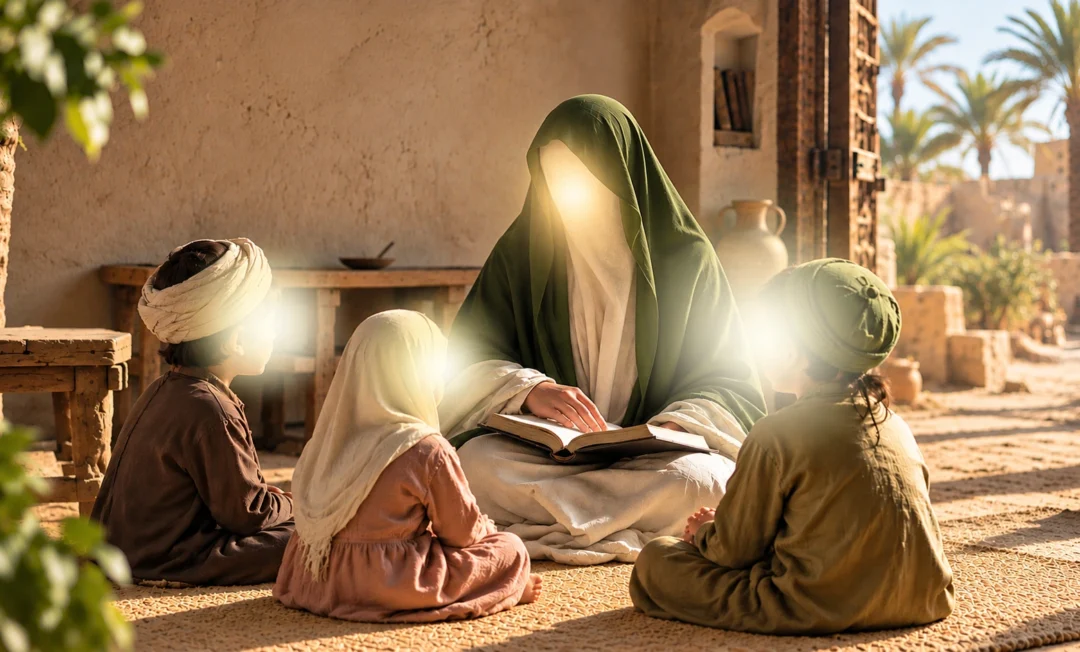
The Home Was Also a Place of Learning
Fatimah’s responsibilities did not prevent her from teaching.
The source describes her spending time teaching religious knowledge to her children and to other Muslims while continuing to manage the household.
Hasan, in particular, is remembered as being encouraged to listen to the Prophet’s teachings and bring what he had learned back home.
In this way, learning did not belong only to the mosque or to formal gatherings.
It entered the home.
The children saw that knowledge was valuable, questions were welcome, and religion was something to be understood as well as practiced.
A Home Where Children Were Loved
The home of Fatimah and Ali was also a place of affection for their children.
Fatimah responded to her children’s emotional needs, played with them, spoke to them affectionately, and encouraged them in good actions.
When Husayn cried while Fatimah was working, she prioritized comforting him while another person continued the household task.
The source also records Fatimah praying for others, teaching her children to worship, and encouraging them to become familiar with the religious life of the family.
These child-centered details belong more fully in our separate article “How Fatimah Raised Her Children,” where they can be explored without making this article feel fragmented.
Cleanliness, Health, and Daily Care
The household also paid attention to physical well-being.
Traditional reports describe Fatimah preparing fresh bread, cleaning the home, washing clothing, nursing her children, and caring for their personal cleanliness. She was attentive to illness and prayed for her children’s recovery when they became sick.
Ali’s teachings also included practical guidance about food, cleanliness, moderation, and personal hygiene.
This gives us another important dimension of the household: spiritual life was not separated from physical care.
A healthy family needs both.
Beauty and Care Within Marriage
Simplicity did not mean neglecting personal appearance.
Traditional sources describe Fatimah as using perfume and paying attention to cleanliness and appearance within the home. The sources also record that perfume was among the items purchased in connection with her marriage.
This can be understood as one expression of consideration between spouses.
A person may live simply without abandoning cleanliness, dignity, or affection.
The same principle applied to both husband and wife: personal hygiene, pleasant appearance, and respectful treatment can contribute to a loving household.
A Home Strengthened by the Wider Family
The household of Fatimah and Ali was not isolated from the wider family.
The Prophet remained closely involved in their lives, and the family continued to be regarded as part of the Prophet’s household. Traditional reports also describe Fatimah bint Asad, Ali’s mother, living with or near the couple for a period without reports of conflict between her and Fatimah.
This aspect of their life is important because it shows another dimension of family stability: maintaining respectful relationships with parents and relatives.
A strong household does not necessarily mean cutting itself off from the wider family.
It means learning how to maintain those relationships with dignity and consideration.
A Home Prepared for Difficult Times
The deepest test of a family is not how it behaves when everything is easy.
It is what happens when hardship arrives.
Fatimah and Ali experienced difficult economic conditions, the absence of Ali during missions, illness among the children, the death of Prophet Muhammad, and the painful political conflicts that followed.
The source argues that their spiritual foundation helped the household face these events without allowing every crisis to destroy its inner stability.
That does not mean that the family never experienced grief.
It means that grief did not erase faith.
What Made Their Home Different?
The traditional picture of Fatimah and Ali’s home can be reduced to something much simpler than a long list of household rules.
They loved one another.
They spoke to one another with respect.
They shared responsibility.
They accepted a simple material life.
They worshipped together.
They served others.
They cared for their children.
And they tried to make their home a place where each person could return from the pressures of the outside world and find dignity, affection, and peace.
The source’s broader conclusion is that family stability depends more upon attitudes and behavior than possessions and material facilities.
A Small Home With a Great Legacy
The physical home of Fatimah and Ali was modest.
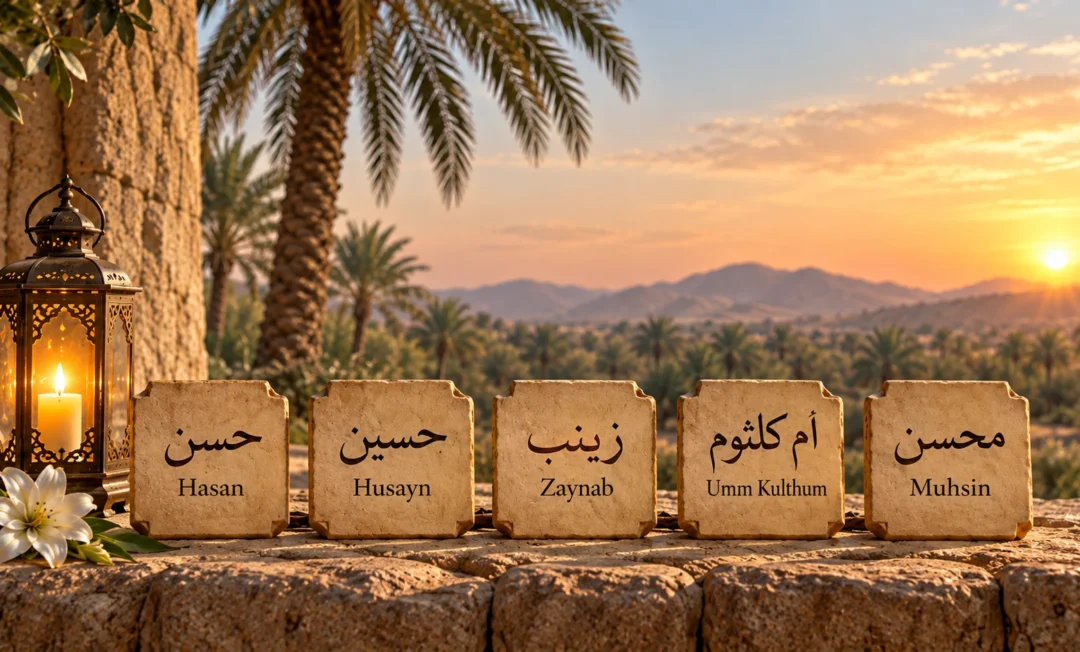
But Hasan, Husayn, Zaynab, and Umm Kulthum were raised within it.
From that household emerged figures who would become central to Islamic memory: Hasan through his patience and reconciliation, Husayn through his stand at Karbala, and Zaynab through her courage and preservation of the message after Karbala.
In Shi’a tradition, the lineage of the later Imams also continues through Husayn, making Fatimah the link between the Prophet Muhammad and the Imamate.
The house was therefore small in material terms, but enormous in historical and spiritual consequence.
The Enduring Meaning of Their Family Life
The home of Fatimah and Ali is remembered not because every day within it was easy, but because hardship did not prevent love, and simplicity did not prevent dignity.
Their story presents a vision of family life in which marriage is more than sharing a house. It is sharing responsibility, protecting one another’s dignity, supporting one another in worship, caring for children, serving others, and remaining together when circumstances become difficult.
That is why the memory of their household continues to hold meaning for Muslim families today.
The lasting lesson is not to reproduce the physical conditions of their home.
It is to understand what made that home strong:
faith that gave it direction, love that gave it warmth, respect that protected it, cooperation that sustained it, and sacrifice that gave it meaning.