
The martyrdom of Fatimah al-Zahra سلام الله عليها cannot be understood by beginning with the attack on her home. To understand why the confrontation happened, we must first go back to the days immediately after the death of her father, the Messenger of Allah ﷺ.
The Prophet’s death brought immense grief to his family and created an urgent question for the entire Muslim community: who would lead the Muslims after him?
What followed was not simply a private disagreement between a few individuals. It was a major crisis concerning succession, authority and the future direction of the Muslim community. The events that unfolded during those days eventually brought political pressure to the home of Ali and Fatimah and, according to the Shi’a tradition, set in motion the tragedy that led to Fatimah’s martyrdom.
The Prophet’s Death
When the Messenger of Allah ﷺ passed away in Medina, his household was overwhelmed with grief. Ali ibn Abi Talib عليه السلام, Fatimah al-Zahra سلام الله عليها and the members of the Prophet’s family were occupied with his final preparations.
According to the historical account provided in the sources, Ali ibn Abi Talib, al-Fadl ibn al-Abbas and Usamah ibn Zayd washed the body of the Prophet ﷺ. The Muslims then came to perform the funeral prayer. First, al-Abbas and Banu Hashim prayed over him, followed by the Muhajirun, then the Ansar, and then the rest of the Muslims, who entered in groups. But the unusual circumstance concerned the burial itself and what was happening at the same time in Medina.
The Prophet ﷺ was ultimately buried in the room where he had lived and passed away. According to the report preserved in the sources, the Companions discussed where the Prophet should be buried, and Ali عليه السلام stated that he had heard the Messenger of Allah say that prophets are buried where they die. His view was accepted, and the Prophet was therefore buried in his own room rather than being carried elsewhere.
The same account states that Ali, al-Fadl ibn al-Abbas and Usamah ibn Zayd entered the grave and completed the burial.
We need to understand the atmosphere in Medina at that moment. The Prophet had only just died, his family was still occupied with his burial, and yet the question of leadership after him had already become a matter of intense dispute. The political crisis that followed would soon bring pressure to the house of Ali and Fatimah—and eventually become part of the tragedy of Fatimah al-Zahra.
The Question of Who Would Lead the Muslims
The central question was not merely:
“Who is the next political ruler?”
For Shi’a Muslims, the question had already been answered by the Prophet during his lifetime.
The Shi’a understanding is that leadership of the Muslim community, like prophethood itself, was not something to be decided simply through political competition. Ali عليه السلام had been designated by the Prophet as his successor through a number of statements and events, most importantly the declaration at Ghadir Khumm.
At Ghadir, the Prophet publicly declared:
“For whoever I am his Mawla, Ali is his Mawla.”
This report is preserved in Sunni hadith literature, including Jami’ al-Tirmidhi and Musnad Ahmad.
The historicity of Ghadir Khumm itself is widely recognized in modern Islamic scholarship. The major disagreement concerns the meaning of mawla. Oxford’s Oxford Bibliographies in Islamic Studies explains that Muslims generally accept the historical occurrence of the declaration, while Shi’a Muslims understand it as a designation of Ali’s leadership and Sunni interpretations understand it primarily as a declaration of Ali’s loyalty, support and elevated status rather than an appointment as political successor.
This difference is fundamental to understanding the events that followed.
What Was the Prophet’s Instruction About Ali?
From the Shi’a perspective, the Prophet did not leave the question of leadership open for the community to decide.
The declaration at Ghadir is understood as the culmination of the Prophet’s public designation of Ali.
The Shi’a argument does not rest upon the word mawla alone. Other prophetic reports concerning Ali’s unique position are also important, including the Prophet’s statement comparing Ali’s relationship to him with Aaron’s relationship to Moses.
At the same time, historical honesty requires us to acknowledge that the Sunni and Shi’a traditions interpret these reports differently.
Even the Cambridge study of early Islamic succession describes the fundamental divide clearly: Sunni tradition regards Abu Bakr as the rightful successor, while Shi’a tradition maintains that Ali had been appointed by Muhammad and that his right was subsequently set aside.
Therefore, when this article says that Ali believed the Prophet had designated him, this is the Shi’a understanding of the succession question, not a claim that all Muslims historically interpreted the Prophet’s words in exactly the same way.
What Happened at Saqifah?
While Ali and members of the Prophet’s household were occupied with the Prophet’s final rites, a gathering took place at Saqifah Bani Sa’idah to discuss leadership.
The meeting resulted in allegiance being given to Abu Bakr.
Modern scholarship treats Saqifah as one of the decisive moments in the development of the early caliphate. Wilferd Madelung’s study of the succession describes the Saqifah assembly as the foundational event through which Abu Bakr’s succession was established.
This is where the disagreement became political.
The Shi’a position was that Ali’s right to leadership had already been established by the Prophet.
The other position was that the community could determine its leader after the Prophet’s death.
That disagreement would soon reach Fatimah’s home.
Why Did Ali Not Give Allegiance Immediately?
This is one of the most important questions in the entire story.
A reader unfamiliar with the history may ask:
“If Abu Bakr had become caliph, why did Ali simply refuse to accept him?”
Sahih al-Bukhari provides an important answer.
Bukhari reports that Ali did not give allegiance during the period following the Prophet’s death and before Fatimah’s death. When Ali later spoke to Abu Bakr, he explained that Abu Bakr and those with him had made the decision without consulting Ali and that Ali and the Prophet’s family believed they had a right in the matter because of their close relationship to the Messenger of Allah.
Thus, Ali’s initial refusal was not described simply as personal stubbornness.
There was a disagreement over who possessed the legitimate right to determine leadership.
From the Shi’a perspective, the answer was even clearer: Ali believed he was the Prophet’s designated successor.
Ali Was Not Simply Fighting for Personal Power
This point should also be made clear.
Ali was not an ordinary political candidate competing for a throne.
He was the Prophet’s cousin, son-in-law and one of his earliest and closest supporters.
The Shi’a understanding is that Ali’s claim was based upon the Prophet’s designation and his religious authority, not merely family ambition.
This is why the dispute over allegiance became so serious.
The issue was not simply:
“Will Ali recognize Abu Bakr?”
It was:
“Who has the right to lead the Muslim community after Muhammad?”
Why Was Ali Still in the House?
After the Prophet’s death, Ali did not immediately participate in the new political arrangement.
The attached sources describe Ali and a number of supporters remaining in the house of Fatimah while attempts were made to obtain his allegiance.
The house was therefore not a center of criminal activity or rebellion in the ordinary sense.
It was the home of:
Ali ibn Abi Talib,
Fatimah al-Zahra,
the daughter of the Prophet,
and members of the Prophet’s household and supporters.
The political authorities wanted Ali to come out and give allegiance.
Ali did not agree.
Was There a Right to Enter Fatimah’s House by Force?
This question must be asked before discussing the door.
A political demand for allegiance does not automatically create a right to violate a private home.
Islam places serious restrictions on entering other people’s homes without permission. The Qur’an instructs believers not to enter houses other than their own until permission has been obtained.
That principle becomes even more significant when the home belongs to the daughter of the Prophet.
The attached documents preserve reports from early historical works describing a threat to Fatimah’s house. Ibn Abi Shaybah is cited as reporting that Umar threatened to have the house burned if those gathered inside did not come out.
Al-Baladhuri is also cited in the supplied material as reporting that Umar came to Fatimah’s house carrying a firebrand and that Fatimah confronted him about the intention to burn the house.
These reports are extremely important because they establish that the confrontation at the house is not simply a modern invention.
The Prophet’s Words About Fatimah
Now another question becomes unavoidable.
Even if there was a political disagreement over Ali’s allegiance, how were people supposed to treat the daughter of the Prophet?
The Prophet’s position toward Fatimah was extraordinary.
Sahih al-Bukhari records the Prophet saying:
“Fatima is a part of me; whoever makes her angry, makes me angry.”
A report transmitted in Muslim gives the same essential principle concerning harm and distress to Fatimah. A contemporary official Jordanian Iftaa’ discussion of the two Sahih collections likewise cites these reports regarding the Prophet’s relationship to Fatimah.
This is not a small statement.
The Prophet was telling the Muslim community that Fatimah possessed a unique relationship to him and that causing her anger and distress was connected to causing him distress.
This is why the subsequent events are so serious.
Fatimah Did Not Need to Be Blamed for Keeping the Door Closed
This is another point that must be explained clearly.
Imagine the sequence from Fatimah’s perspective.
The Prophet, her father, had just died.
Her husband was being called to give allegiance to a leadership he did not recognize as legitimate.
A group of armed men had come to the house.
A threat of burning the house had been made according to the historical reports.
Why would Fatimah have been obligated to open the door?
There is no principle by which a woman loses the sanctity of her home merely because political authorities demand access.
On the contrary, the Qur’an establishes the general principle of seeking permission before entering private homes.
Therefore, the moral burden in the confrontation is not automatically placed on Fatimah because she did not open the door.
Why Did Fatimah Come to the Door?
According to the attached sources, Fatimah did not remain behind the door simply because she was afraid.
She came forward because she understood that Ali was the target.
The sources describe her challenging those outside and reminding them of the Prophet and his treatment of his family.
Her action was therefore understood in Shi’a tradition as an act of defense.
She was defending her home.
She was defending Ali.
And, more importantly, she believed she was defending the Prophet’s command concerning his household and Ali’s wilayah.
The Threat Became an Assault
Here the sources diverge in detail.
The attached material makes an important distinction: the threat to burn the house is supported by reports in early Sunni historical sources, while the full account of the physical assault belongs principally to the Shi’a narrative and is disputed in Sunni historiography.
The Shi’a reports describe a much more violent sequence.
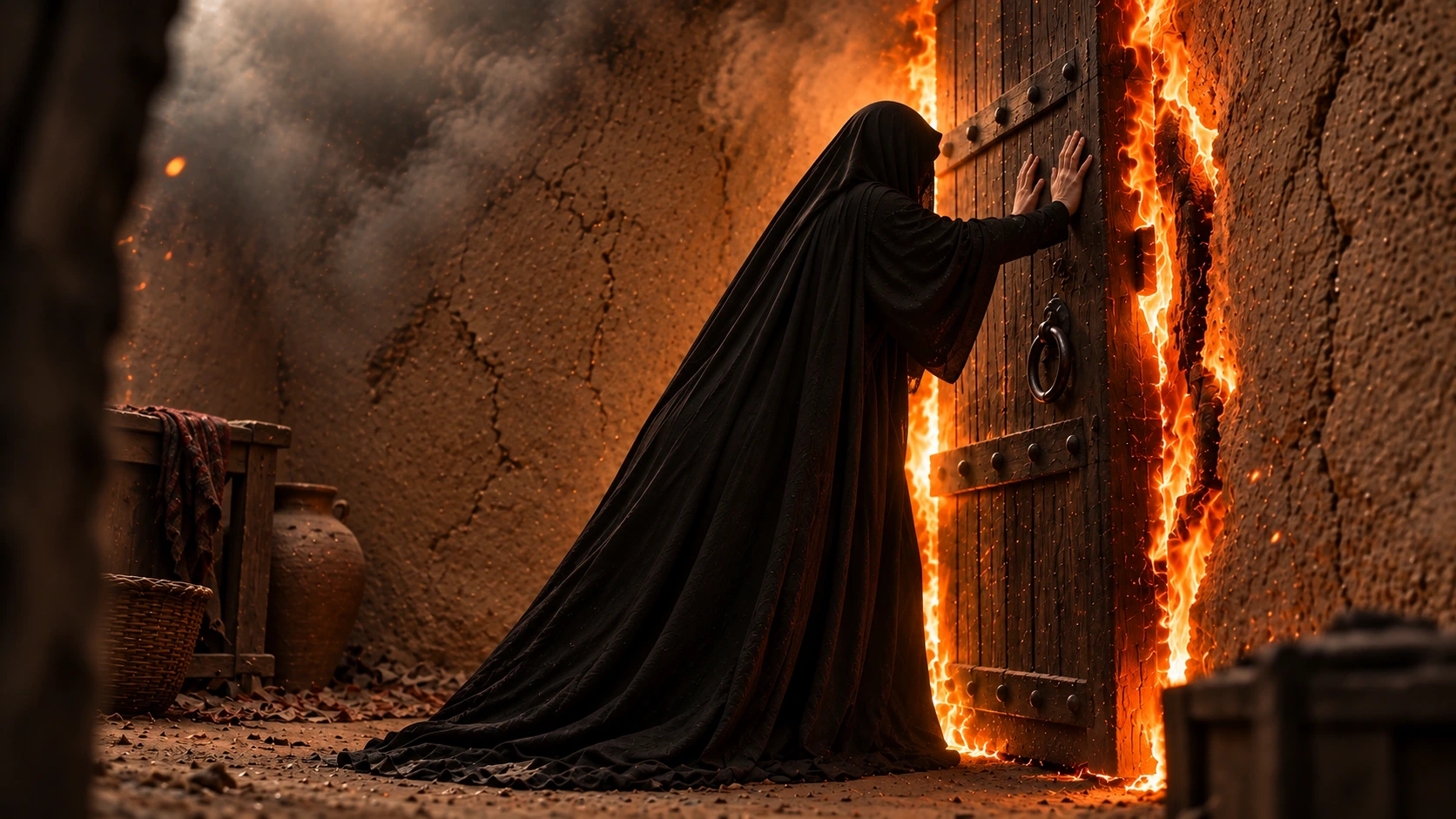
They say that the door was forced open while Fatimah was behind it.
She was injured.
Her unborn son Muhsin was lost.
And she subsequently became seriously ill.
Another report in the supplied documents attributes blows to Qunfudh and links the injury, miscarriage and subsequent illness to the events at the house.
For Shi’a Muslims, these reports explain why Fatimah’s later death is regarded as martyrdom.
Why Did Ali Not Draw His Sword?
This question must now be understood in its proper context.
Ali was not simply watching a stranger enter his home while doing nothing.
According to the Shi’a explanation preserved in the supplied sources, Ali was faced with a terrible choice.
He could begin an armed confrontation immediately.
Or he could endure the injustice in order to prevent a larger civil war and preserve the Muslim community.
The attached material explains Ali’s patience as an act of obedience and restraint. It argues that he understood that armed resistance could turn the dispute into a general conflict and give his opponents the opportunity to portray the struggle as a battle for political power.
Therefore, his silence should not be mistaken for cowardice.
The Shi’a interpretation sees it as deliberate sacrifice.
Fatimah Defended Ali Even When She Was Injured
The supplied accounts describe a further moment of extraordinary courage.
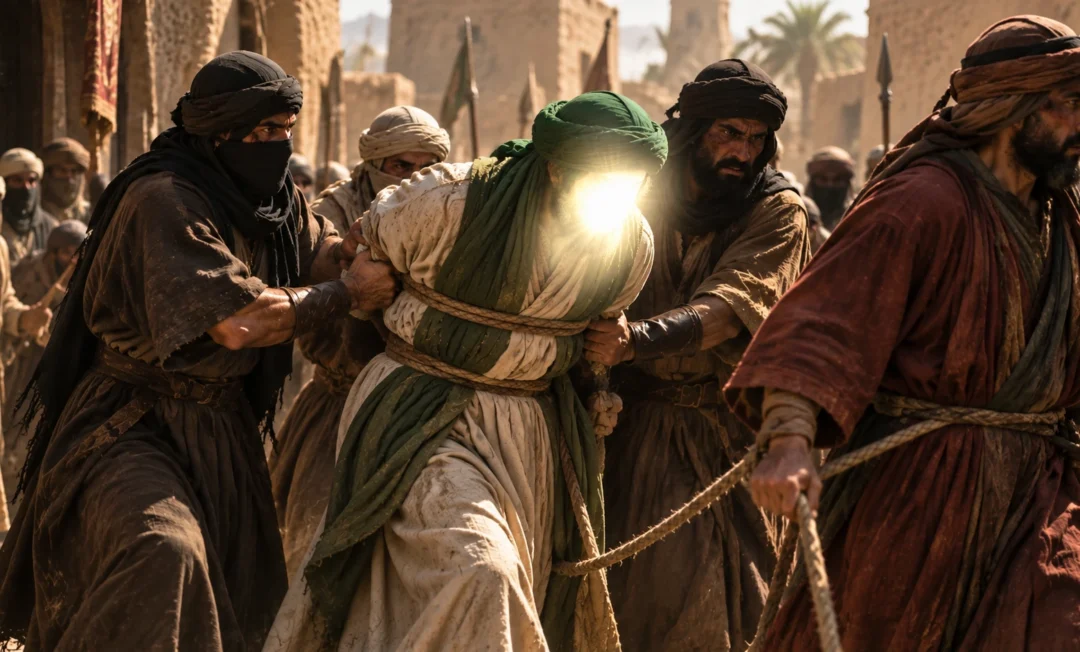
When Ali was taken away, Fatimah followed him.
She held onto him and protested the way he was being treated. Later, when Ali was taken toward the mosque, she went after him despite her condition and demanded that he be released.
This destroys the mistaken image of Fatimah as someone who passively remained inside while Ali faced everything.
According to these reports, Fatimah was one of the principal defenders of Ali.
Why the Events Cannot Be Separated
The death of Fatimah cannot be understood by looking only at the final days of her illness.
Her final suffering must be seen within the larger sequence:
The Prophet died.
The question of succession immediately became contested.
Saqifah resulted in allegiance to Abu Bakr.
Ali did not immediately accept the new political arrangement.
Efforts were made to obtain his allegiance.
The confrontation reached Fatimah’s home.
Historical reports preserve threats against the house.
Shi’a reports describe a physical assault.
Fatimah suffered serious injuries and lost her unborn son, according to those reports.
She became ill.
And she eventually died.
The attached material explicitly identifies these three dimensions of suffering: the grief of losing the Prophet, the political rupture surrounding succession, and the physical injuries associated with the attack.
What Sunni Sources Preserve About Her Final Months
Even where Sunni and Shi’a traditions disagree over the physical assault, the Sunni canonical record still preserves an extraordinary picture of Fatimah’s final months.
Sahih al-Bukhari reports that Fatimah remained angry with Abu Bakr until her death, lived approximately six months after the Prophet, and was buried by Ali at night without Abu Bakr being informed.
The report also says that Ali had not pledged allegiance during those months and only later sought reconciliation with Abu Bakr.
These details should not be hidden from readers.
They are among the most important pieces of evidence in understanding why the final months of Fatimah’s life remain such a significant historical question.
Fatimah’s Final Illness
According to the supplied reports, Fatimah’s health deteriorated after the events at her home.
The Shi’a tradition connects her illness directly to the injuries she suffered.
The attached sources describe her spending her final days in a state of weakness while preparing herself spiritually for death.
She asked for water.
She washed herself.
She put on clean clothing.
She used perfume.
She faced the qiblah.
And she prepared for the meeting with Allah.
Her Final Prayer
One of the most moving reports in the supplied material describes Fatimah raising her hands toward heaven and praying.
She remembered her father Muhammad ﷺ.
She remembered Ali.
She remembered Hasan and Husayn.
She remembered her daughters.
And she prayed that Allah would show mercy to the sinners of the Prophet’s community.
Even in the final hours of a life marked by suffering, the report presents Fatimah turning toward Allah.
Her Last Moments
Fatimah asked Asma’ bint Umays to give her some time alone.
She told her that if she answered when called, she would still be alive.
But if she did not answer, Asma’ should inform Ali that she had died.
Asma’ returned.
She called Fatimah.
There was no answer.
She lifted the covering from her face.
Fatimah al-Zahra had died.
Hasan and Husayn Lose Their Mother
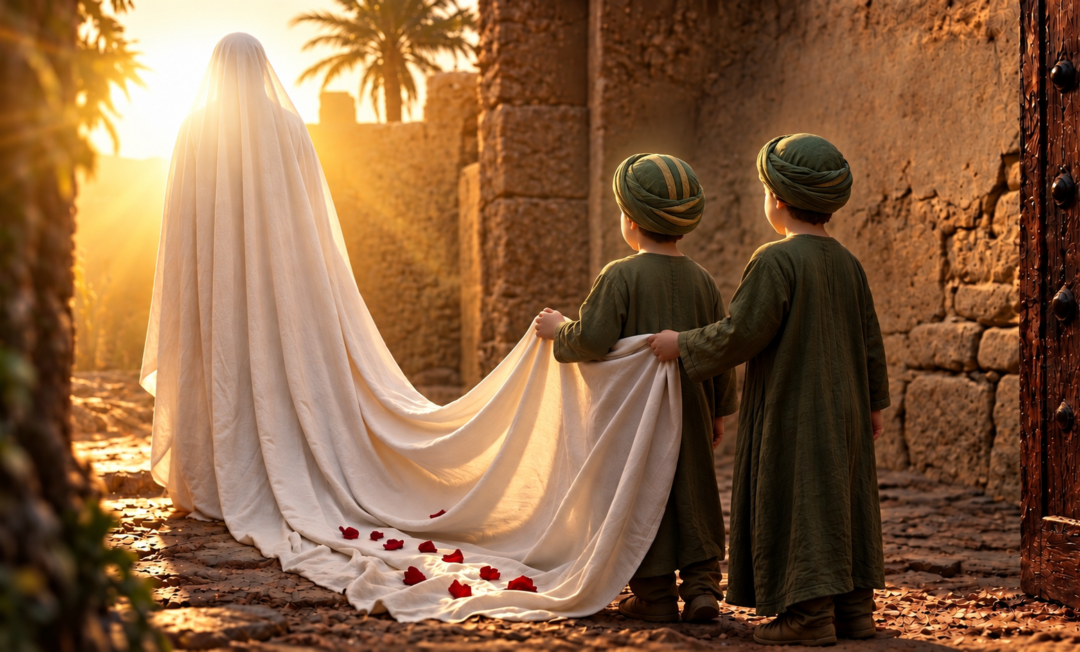
Hasan and Husayn entered and learned that their mother had passed away.
The supplied account describes them embracing and kissing her, crying and asking her to speak to them. They then went to inform their father.
For these two children, the loss was devastating.
They had already lost their grandfather.
Now they had lost their mother.
Ali’s Grief
When Ali received the news, the attached reports describe him as overwhelmed by grief.
The words attributed to him reveal the depth of his dependence on Fatimah’s companionship:
She had been his source of consolation.
Now she was gone.
The supplied account preserves his grief as one of the most painful moments following Fatimah’s death.
The Final Journey of Fatimah
Fatimah’s final wishes were then carried out.
According to the supplied reports, Ali performed or supervised the washing and shrouding of her body, with Asma’ assisting. Hasan and Husayn brought water, while Zaynab, Umm Kulthum and Fiddah were among those present in the household. She was shrouded and prepared for burial.
Before the shroud was closed, Ali called Zaynab, Umm Kulthum, Hasan and Husayn to say farewell to their mother. The reports describe their grief as they embraced her one final time.
The funeral prayer was then performed.
The reports differ over the precise list of those present, but all emphasize the private nature of the burial. One account mentions Ali and Husayn, while other reports list Hasan and Husayn together with close companions such as Salman, Abu Dharr, Miqdad, Ammar and others.
Fatimah was then buried at night.
Why Was Her Funeral Private?
The nighttime burial was not an accidental decision.
According to the Shi’a reports, it was part of Fatimah’s own instructions.
Even more significantly, Sahih al-Bukhari independently records that Ali buried her at night and did not inform Abu Bakr.
This means that whatever position a reader takes regarding the disputed details of the assault, the unusual character of Fatimah’s final burial must still be confronted.
Her funeral was private.
Her burial took place at night.
And her grave became difficult to identify.
A Tragedy That Cannot Be Reduced to One Moment
The martyrdom of Fatimah al-Zahra is therefore not simply the story of one blow, one door or one day.
It is a story that begins with the death of the Prophet ﷺ and the sudden political crisis that followed.
It is a story about a disagreement over succession.
It is a story about Ali refusing to immediately surrender what he believed was his God-given and Prophet-designated right.
It is a story about Fatimah standing beside him.
It is a story about the sanctity of the Prophet’s household.
It is a story about a confrontation that early sources preserve in differing forms.
And in the Shi’a understanding, it is finally the story of a woman who suffered physical injury, illness and death because she refused to abandon the truth she believed her father had entrusted to her.